


High-speed thermoform finishing: laser scan
Thermoform finishing calls for very high speeds. Beyond a certain point, the robot alone is no longer enough.
Once those speeds are reached, the robot can no longer guarantee cutting precision. The laser scan is the answer to this problem.
How the laser scan works
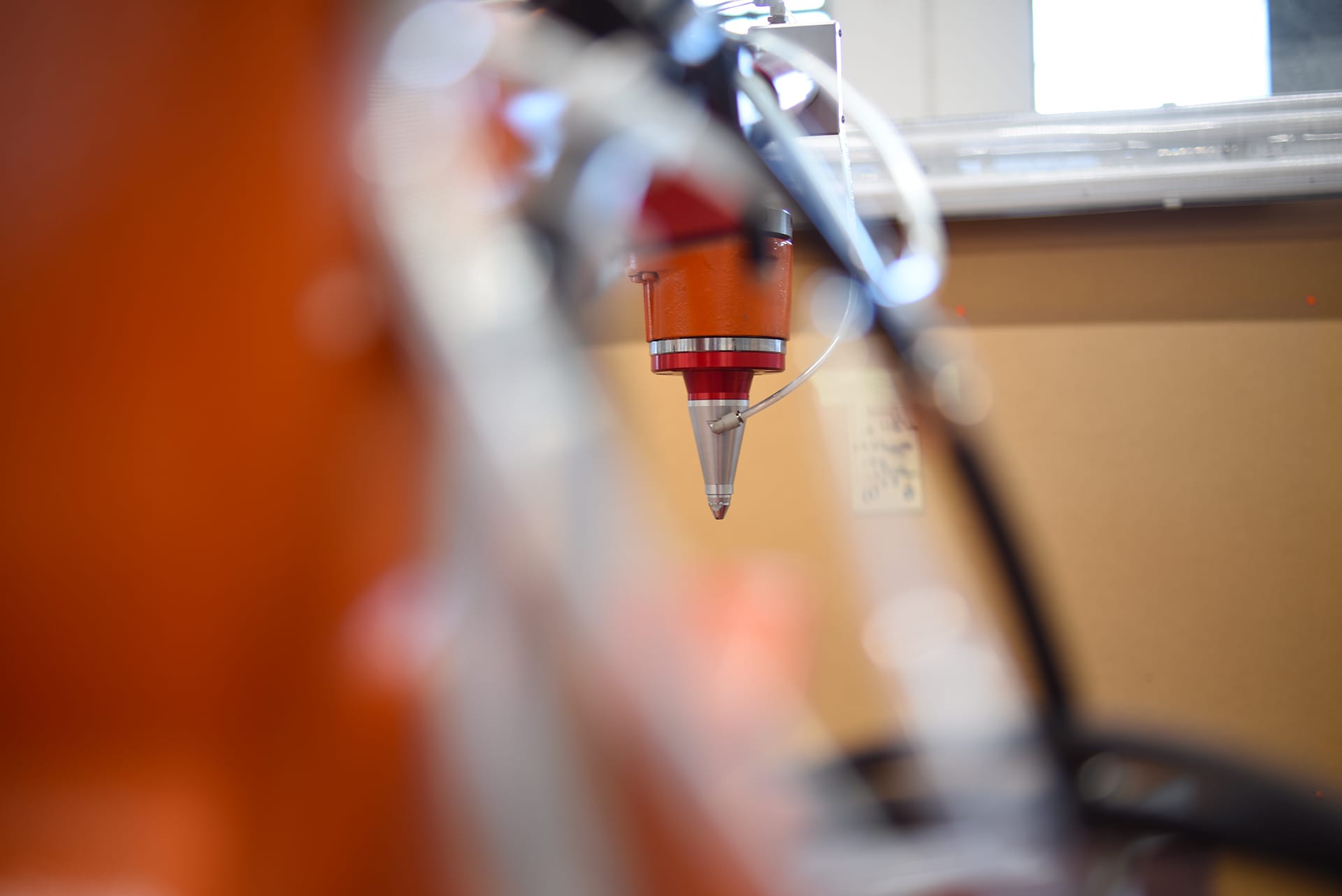
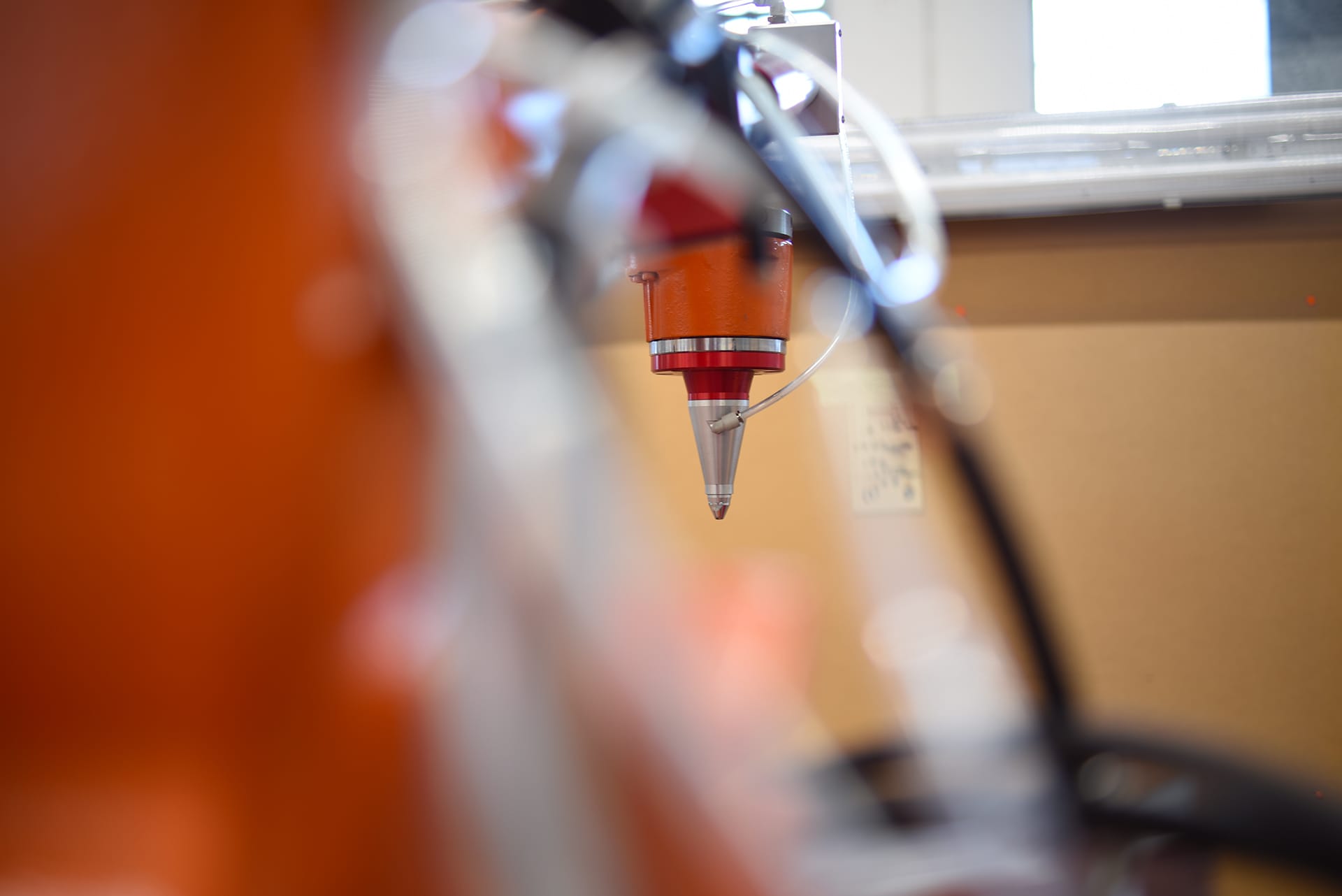
The main advantage of the laser scan lies in the perfect execution of the cutting geometry. The scanning head is mounted on the robot wrist: the laser beam, focused by a special lens, is moved by two mirrors mounted on two galvanometers, with their axes perpendicular to each other.
The lens, positioned upstream of the galvanometers, features a linear galvanometer that ensures correct focusing of the laser beam at every point of the laser scan working field.
The working field is set by the manufacturer, optimizing the scan cutting times against the time the robot needs to reach each position. A fairly small field is generally chosen, for example 200×200 mm², to cut at the highest possible speed and thus offset the robot's longer travel times.
The laser scan is mounted on the robot wrist: as soon as the robot reaches the cutting area, it gives the go-ahead to the laser scan, which performs the cuts planned within its working field.
The robot positions. The laser scan cuts.
A practical example
Imagine having to make, on a thin flat sheet, two holes of different diameter in one area and two squares of different side in another area of the sheet.
Starting from home, the robot program positions it so that the two holes fall within the laser scan working field. Once in position, the robot commands the two-hole program to run. When the cut is finished, the scanner releases the robot to move to the next area, where the laser scan runs the cutting program for the two squares.
Once the operation is over, the laser scan signals the robot to return to the starting position, ready for the next job.
Programming the laser robot system with laser scan
The laser robot system, equipped with the laser scan, requires two different types of programming:
- the cutting paths, which can be programmed off-line and then loaded onto the scanner controller;
- the sequence of positions the robot must take, generally created by self-teaching, taking care to position the scanner at the correct focal distance from the cutting plane.
The laser robot with laser scan is used to finish thermoformed parts whose walls are mostly thin, such as refrigerator cells or freezers (inner liners).
These thermoformed parts have surfaces even thinner than a millimeter, on which cutting speeds above 25 m/min (420 mm/s) are reached. Despite the high speed, the system maintains the cutting geometry with great accuracy.
Some examples were obtained with the RX3 system equipped with laser scan and an RF899 laser source made by Cutlite Penta: these openings, cut on a 1 mm thickness, were made at a speed of 22 m/min.
Frequently asked questions
What is laser scan?
A system where the scanning head is mounted on the robot wrist and moves the beam with two mirrors on galvanometers, for very high-speed finishing.
Why is the robot alone not enough?
Because beyond a certain speed the robot can no longer hold the profile accuracy: laser scan compensates by moving the beam, not the arm.
Where is laser scan finishing used?
On thermoformed components, for trimming and openings, composites included.
What is the main advantage of laser scan?
Faithful execution of the cutting geometry even at high speed, with no physical contact with the part.
Discover what a Cutlite Penta laser can do for your production
Tell us about your work: we'll help you find the laser system best suited to your materials, volumes and goals.
