


Plasma or laser cutting: what are the differences for sheet metal?
Same goal, different uses. The difference is thickness, precision and finish.
In sheet metal cutting, laser cutting and plasma cutting have similar goals but distinct uses: the laser offers excellent precision and finish up to 35-50 mm, while plasma is suited to thick material where aesthetic precision matters less. Let's look at the main differences.
The main features of laser cutting and plasma cutting
Laser cutting machines
Laser cutting machines (LASER stands for Light Amplification by Stimulated Emission of Radiation) are based on the emission of a monochromatic, particularly straight light beam.
Laser technology is perfect for working thin and delicate sheets — for instance from 5 to 12 mm — but also medium thicknesses, such as 20 mm. For three fundamental reasons:
- the laser light beam concentrates great power onto limited surfaces;
- the low thermal impact on the plate;
- the extreme cutting precision, which makes further processing unnecessary.
Until recently the technological limit was around 20 mm; beyond that, plasma was preferred, as laser machines rarely exceeded 20-25 mm and speed was still poor.
Today there are high-power fiber sources (8, 10, 12, 15 and 20 kW) and the thickness limit has risen to 35-50 mm. By exploiting high power you cut iron, stainless and aluminium well beyond 20 mm, at competitive speed and with an excellent surface finish combined with great precision.
Laser cutting systems are particularly advantageous because they:
- Deliver clean, precise cuts, free of burrs on the surfaces.
- Require no further downstream processing.
- Have lower operating costs than plasma.
- Use very few consumables compared with plasma.
- Allow perfect drilling under thickness (Ø 5 mm holes on 20 mm thickness).
- Also cut stamped and deep-drawn surfaces.
- Also process semi-finished and already-coated materials.
Plasma cutting for sheet metal processing
Plasma cutting, discovered more than fifty years ago, is used to process various conductive metal materials of greater thickness (stainless steel, aluminium, copper, brass).
Plasma cutting exploits energy and heat: a gas jet is sent to a torch and ionized at high temperature, either by an electric arc or by a high-frequency inductor. The mixture is made of hydrogen and nitrogen; through a nozzle a high-pressure gas is blown which, through electrical interaction with an electrode, becomes plasma, transfers heat to the metal bringing it to melting point and breaks its continuity.
With a plasma machine you get fairly precise but not excellent work: the metal residues after the cut must be removed manually afterward.
Plasma machines also cut non-ferrous metals. For more "delicate" alloys such as carbon steel, however, it is preferable to limit plasma to smaller thicknesses done manually: automatic cutting would be less precise.
| Laser cutting | Plasma cutting |
|---|---|
| Perfect for thicknesses up to 35-50 mm | Ideal for thick material |
| High precision and finish | Presence of micro-imperfections |
| Excellent value for money | — |
| Low operating costs | — |
| Nesting optimization and reduced scrap | — |
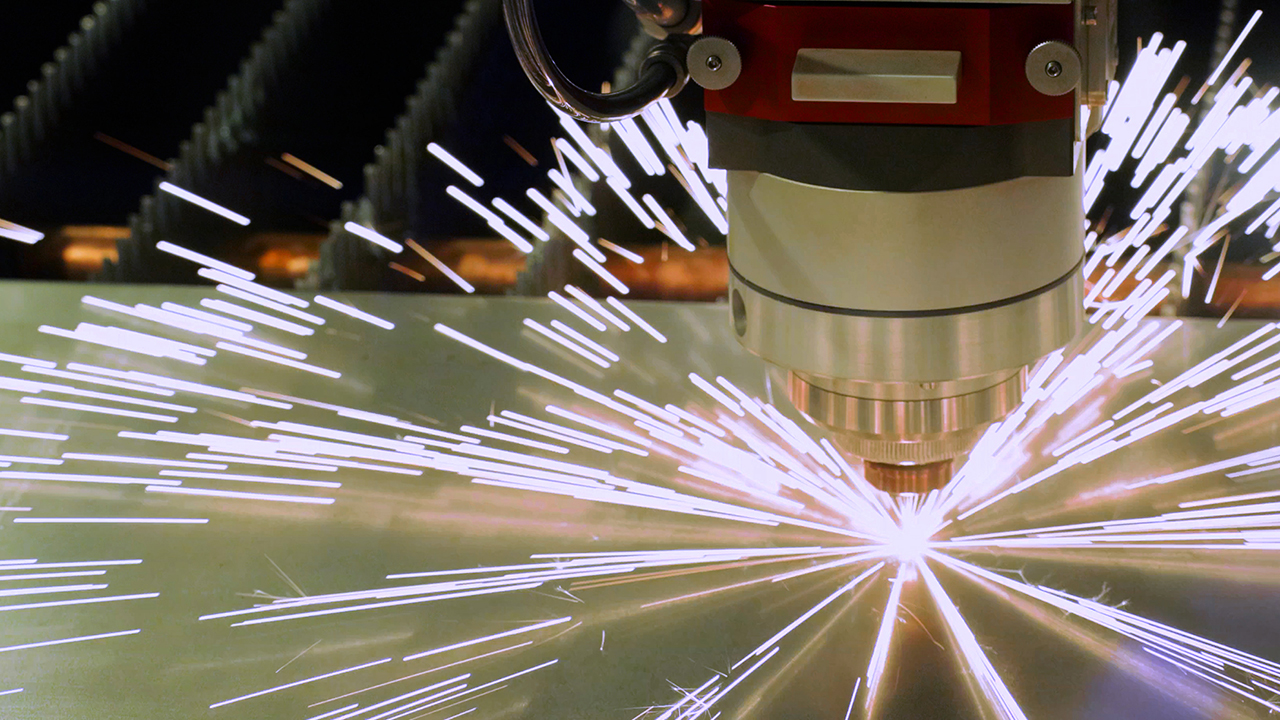
What are the advantages of plasma cutting?
Plasma cutting is today ideal for sheets thicker than 35-40 mm: for example in heavy carpentry or where particular aesthetic precision is not required.
Unlike the laser, plasma can more easily show micro-imperfections on the surface: the cut is not perpendicular and the finish is mediocre, while the holes are of poor quality and often have to be redone by hand with other workshop machines. The laser, on the other hand, reduces plate scrap and optimizes nesting.
Plasma tolerances are two orders of magnitude higher than the laser's: we are talking millimeters with plasma versus a few hundredths of a millimeter with the laser.
Millimeters with plasma, hundredths of a millimeter with the laser.
What to choose between laser cutting and plasma cutting?
With the arrival of high-power fiber laser sources, many jobs once done on plasma can today move to laser machines.
The main advantages are the quality of the cut parts and productivity on low and medium thickness sheets. In addition, the fiber laser has much lower fixed costs for consumables (nozzles, ceramics, protective windows) than those of plasma (torches, electrodes), with a considerable material saving thanks to nesting optimization.
On plasma machines the component replacement times go from a few seconds (simple operations) to several minutes or hours (complex operations, with subsequent setup and test cuts).
This heavily affects machine availability: unlike the laser, a plasma machine is down several hours every month for routine maintenance and setup.
In light of these differences — which weigh on final production — the fiber laser is increasingly appreciated on the market. It is widely embraced for work traditionally done with plasma, which today makes sense above all for thick material.
Cutlite Penta offers your company high-performance fiber laser machines, with a low purchase cost, and large special systems able to interpolate work in 3D and in space. Take a look at our technological offer.
Frequently asked questions about laser and plasma cutting
Is laser or plasma cutting better for sheet metal?
It depends on the required thickness and precision: the laser is perfect up to 35-50 mm with an excellent finish, while plasma suits thick material where aesthetic precision matters less.
What thickness can the fiber laser cut?
With high-power fiber sources (8-20 kW) the laser cuts iron, stainless and aluminium up to 35-50 mm thick, at competitive speed.
Why does laser cutting cost less than plasma to run?
Because it uses cheaper consumables (nozzles, ceramics, protective windows) than the torches and electrodes of plasma, has less downtime and reduces scrap thanks to nesting optimization.
When is plasma cutting still worthwhile?
For thick material (over 35-40 mm) and where particular aesthetic precision is not needed, for example in heavy carpentry.
Move to laser sheet-metal cutting with Cutlite Penta
Tell us your thicknesses, materials and volumes: we will help you see whether and how the laser can replace plasma in your work.
