



How to optimize the workflow around your laser cutting machine
Buying the fiber laser is the first step. Your delivery time, though, is decided by everything that happens around the machine.
Optimizing the workflow of a laser cutting machine means working on four fronts: loading and unloading automation, material handling, software and cutting parameter setup. The market asks for high quality and short lead times, and these four points decide whether you get there with processes your company can sustain over time. Let's go through them one by one.
What fiber laser brings to production
Compared with plasma cutting or CO2 lasers, fiber laser runs at higher efficiency: for the same work it draws less energy, and that shows up in running costs. Cut quality is higher thanks to precision: cleaner edges, often with no finishing step, which means less time to the finished part.
Another strong point is repeatability, which comes from the stability of the beam out of the optical fiber. With linear motors and more advanced motion systems you run faster while holding quality steady over time: exactly what large-scale production needs, where the customer has to get the last part as good as the first. Reduced maintenance and the service life of optics and mechanics complete the picture over the long run.
With ultra-high-power systems, such as our 50 kW, fiber laser now reaches thicknesses that used to require different, more expensive processes to run. Still, there are solutions that optimize the workflow further. Which ones?
Solutions to optimize the cutting process
Adopting a fiber laser system is the first step. To get the most out of it, the solutions upstream and downstream of cutting have to be integrated too.
Automatic loading and unloading
Loading and unloading material is one of the first causes of longer lead times: handling parts is awkward and creates dead time that breaks the cycle. An automatic loading and unloading system cuts the downtime between jobs, automating sheet change and material positioning. The benefits go beyond speed:
- Lower risk of damaging the material
- Lower risk of injury for operators
- Fewer repetitive tasks
- People deployed more productively
- More predictable times and costs
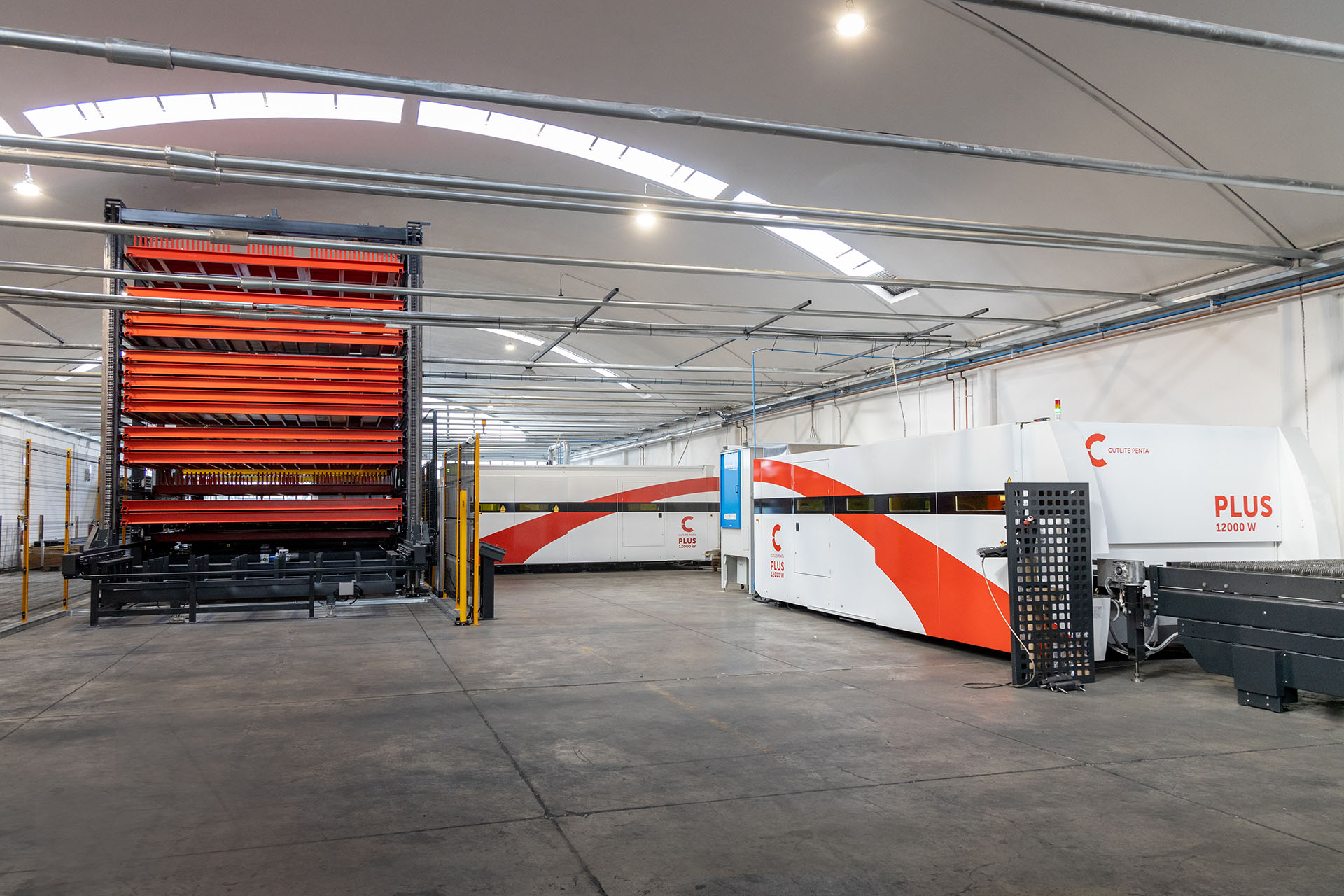
Automated storage
Like loading and unloading, an automatic storage system cuts the handling time for raw material and semi-finished parts. Connected to the production management software, it organizes material picking in an orderly way and keeps operations continuous. It has to be designed around where machines and material actually sit in your plant, and around the existing workflow: this is where tailored configurations make the difference.
Reliability and machine build
Not all fiber laser systems deliver the same efficiency. Much depends on build quality: our systems use high-performance linear motors, which hold precision and speed steady, and the Evo 4 cutting head, designed in-house and able to run up to 50 kW. A well-built machine protects production continuity and cuts the cost of downtime.
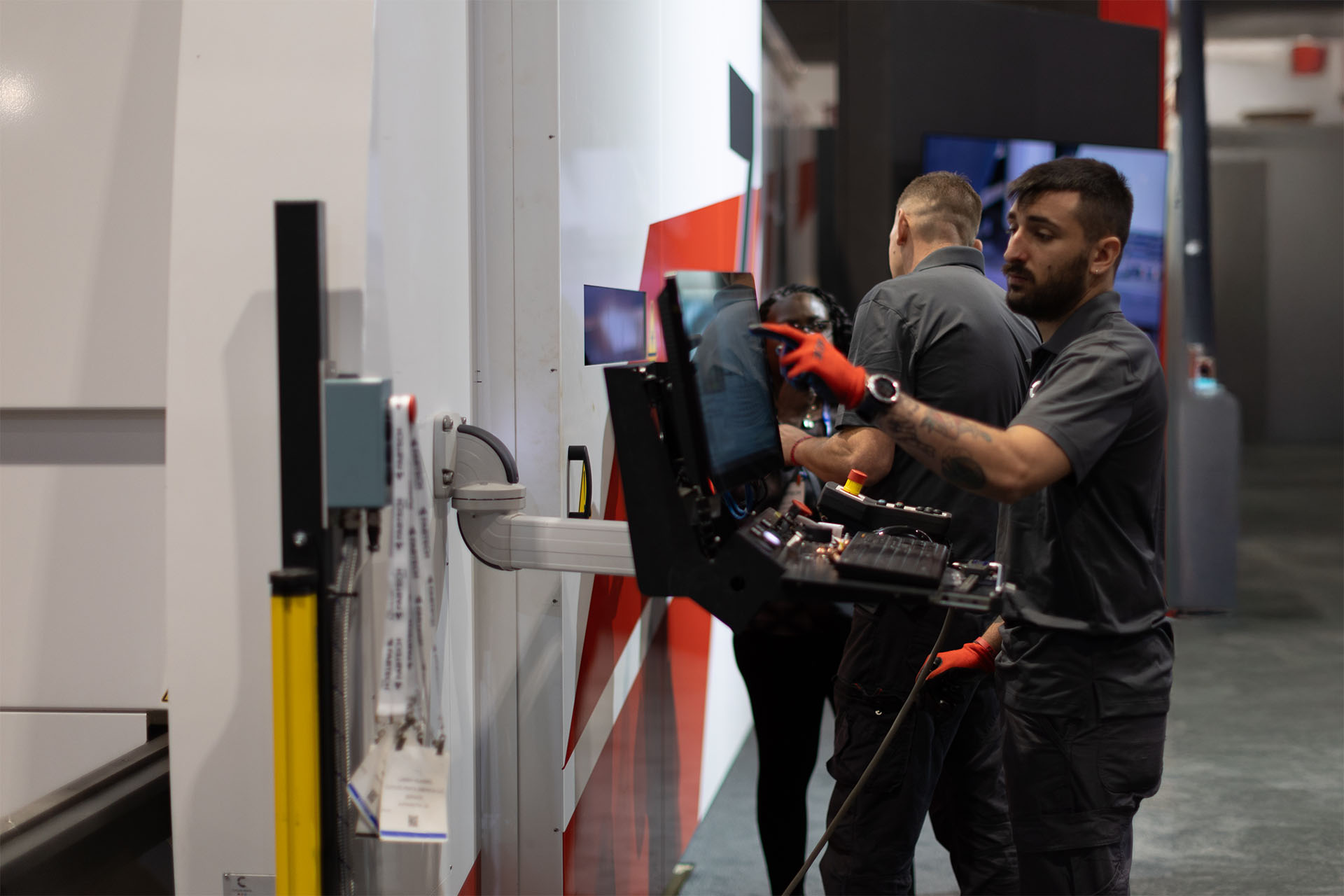
Control software
Control software reduces the chance of error and makes the operator's job simpler: it shortens set-up times and keeps the system in the right working conditions. Integration with company management systems lets you follow production in real time and plan jobs better, while a clear interface makes changing cutting parameters quick.
Nesting and common-cut
To save time and material, parts have to be laid out on the sheet as compactly as possible. Advanced nesting software optimizes that layout, improves material yield and cuts costs. Fiber laser also allows common-cut, sharing the same cutting line between two adjacent parts: with plasma that is not possible.
Fiber laser cutting parameters
To get the result you want, process parameters have to be set carefully: each one acts directly on the process and on cut quality.
- Beam polarization: affects how energy is distributed and how uniformly the laser penetrates the material.
- Wavelength: fiber lasers work around 1.06 µm, the right wavelength for metals, because it ensures high absorption and a precise cut.
- Power and intensity: set according to material thickness and feed rate. More power allows thicker material to be cut with straight edges.
- Cutting speed: affects the finish. Too fast leaves burrs, too slow causes overheating and distortion.
- Assist gas: oxygen, nitrogen or gasmix (nitrogen and oxygen together) change the type of cut, the quality and the speed.
- Focal point: set according to thickness and reflectivity of the material, and it is what makes the cut uniform.
- Material properties: every metal behaves differently and affects cut quality.
Knowing these parameters and how they influence each other means you can set up the job without damaging the laser system or ruining the material. This is exactly what our technicians work on: tuning every parameter to the specific job.
Cutlite Penta systems: automation and tailored configurations
Our fiber laser systems for metal cutting include ultra-high-power solutions, designed for heavy thicknesses and large formats too. They are built entirely in-house, in Tuscany, and use our proprietary cutting head.
We also develop our automatic loading and unloading systems in-house, configurable in line or at 90°, and combinable with automatic vertical storage towers. These systems talk directly to the laser machine, so the workflow does not stop.
Hardware accessories
Accessories can be fitted to the machines to reduce idle time and raise the repeatability of the work. For example:
- Automatic nozzle change: the machine replaces the nozzle without the operator stepping in, reducing downtime.
- Position camera: lets you follow the machine's work, remotely too.
- GASMIX: for mixing nitrogen and oxygen.
- Automation: a range of options to improve the efficiency of production processes.
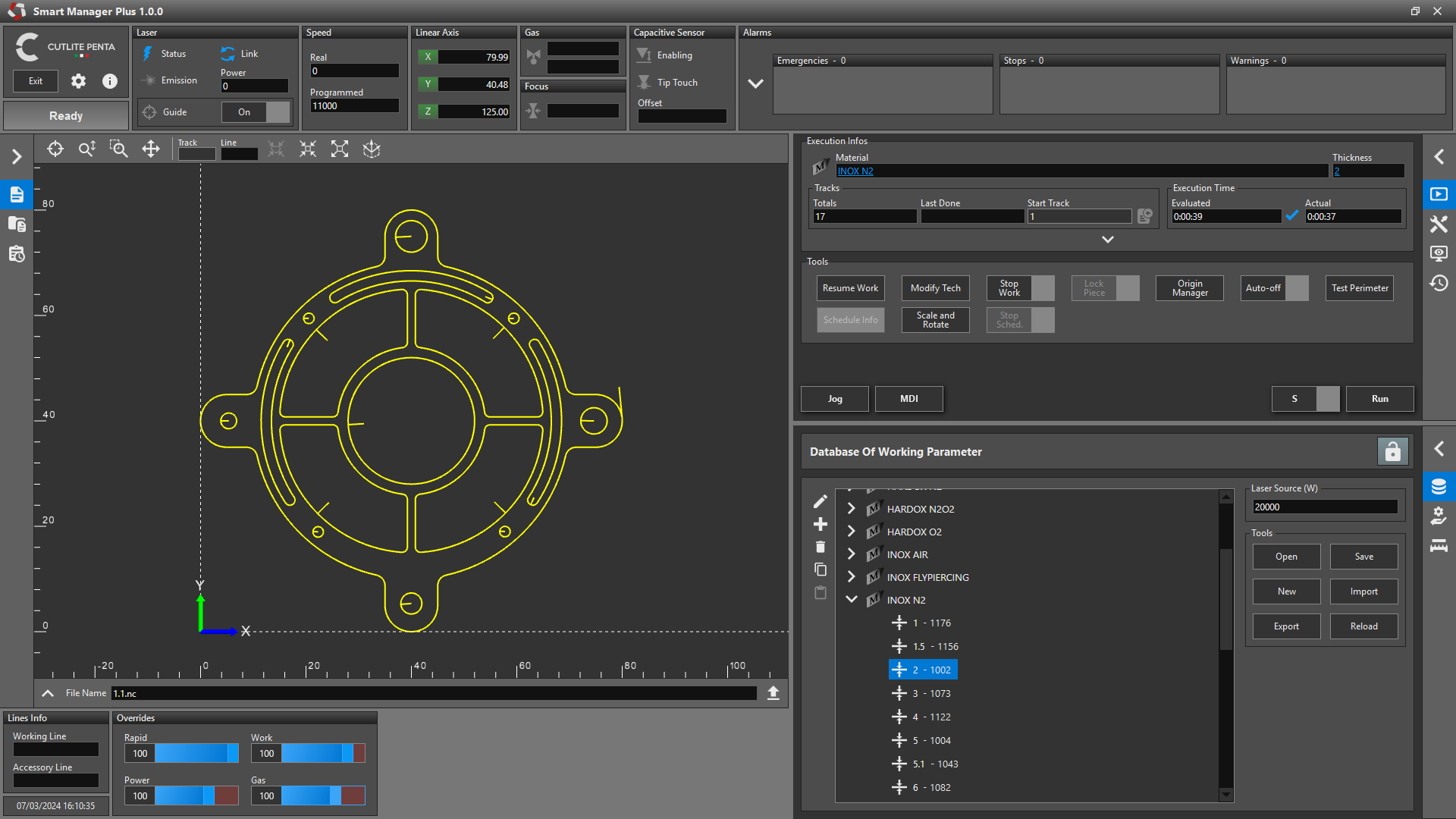
The software: Smart Manager Plus
Smart Manager Plus is the control system shared across our machines: it oversees the machine in all its cutting parameters, managing power through the different cutting phases and the geometries of the part to be produced. All Cutlite Penta systems can also be reached for remote support, over the internet and TeamViewer.
Advanced laser systems with integrated automation are the basis of a shop that produces without hiccups. To the advantages of fiber laser we add dedicated support and tailored configurations, built around the work your company actually does.
Frequently asked questions
How do you optimize the workflow of a laser cutting machine?
By working on four fronts: loading and unloading automation, automatic storage connected to production management, control and nesting software, and careful setup of cutting parameters. The machine alone is not enough: it is the dead time around cutting that decides your lead time.
Which parameters affect fiber laser cut quality?
Beam polarization, wavelength (around 1.06 µm in fiber lasers), power and intensity, cutting speed, assist gas, focal point and material properties. They have to be set together, because they influence each other.
What is nesting, and what does common-cut change?
Nesting is laying parts out on the sheet as compactly as possible, to reduce scrap. Common-cut lets two adjacent parts share the same cutting line, saving time and material: fiber laser can do it, plasma cannot.
What is an automatic loading and unloading system for?
To remove the dead time between jobs: it automates sheet change and material positioning. It also reduces the risk of damaging the sheet, the risks for operators and repetitive tasks, making times and costs more predictable.
Discover what a Cutlite Penta fiber laser can do for your production
Tell us about your work: we'll help you find the laser system best suited to your thicknesses, volumes and goals.
