


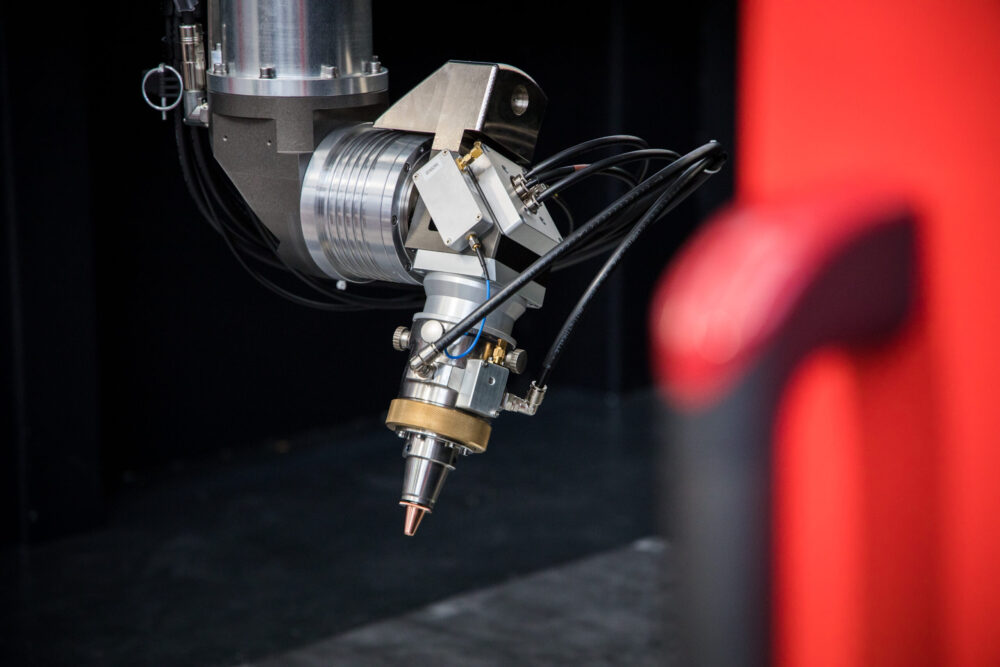
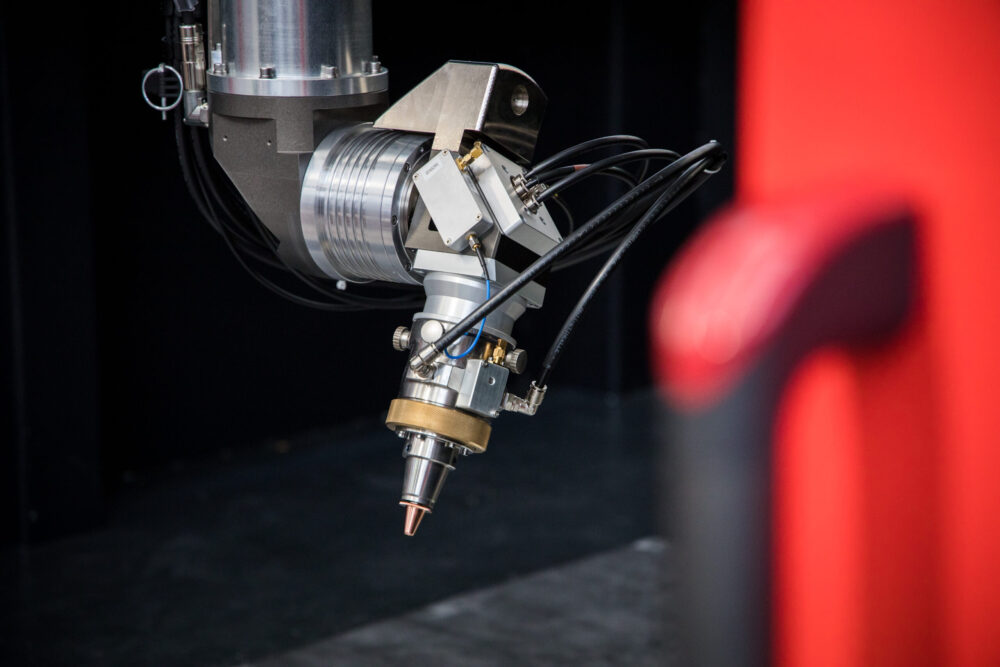
Laser for industry: the Cutlite Penta solutions
From automotive to aerospace: wherever industry cuts metal, there is the laser.
Laser cutting is the technology industry uses to produce parts and components — in 2D and 3D — for large-scale structures and equipment. With the right laser systems you work from "heavy" to "light" industries, with high cutting standards and great efficiency.
How does laser cutting work for industry?
The electromagnetic radiation beam from the source is focused by a lens onto the surface of the material to be cut, which heats up and quickly melts.
At the same time a gas flow coaxial to the beam exits a nozzle downstream of the lens: it produces a fluid-dynamic thrust strong enough to expel the molten material, generating the cut kerf. The system then moves the beam along the desired path.
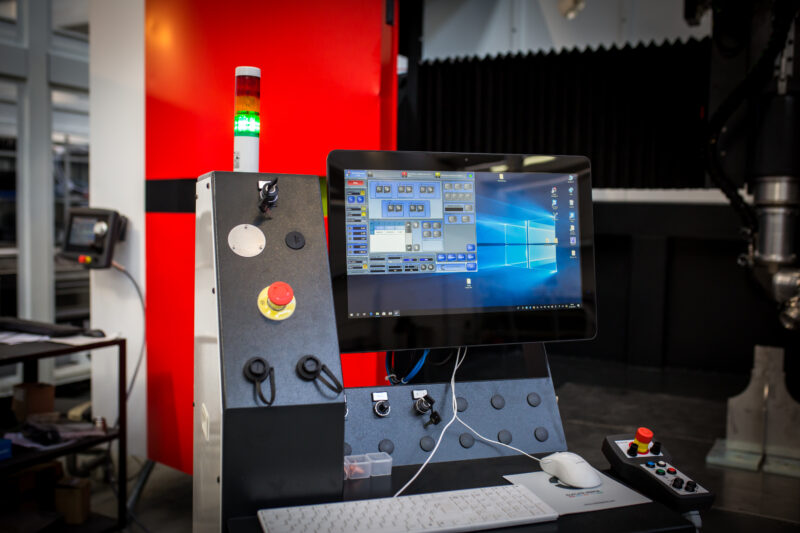
The most modern machines use computer guidance: the CNC directs the machine's actions with extreme precision that rules out human error. This is how components of various shapes are made and tubes, tubulars and metal profiles of different thicknesses and alloys are cut.
Laser cutting for industry: fiber or CO2?
Cutting is one of the first operations in sheet metal shaping, and laser technology has shaken up the industrial sector, proving innovative in carpentry and beyond. Cutlite Penta laser systems for metal cutting are designed for the production needs of industry.
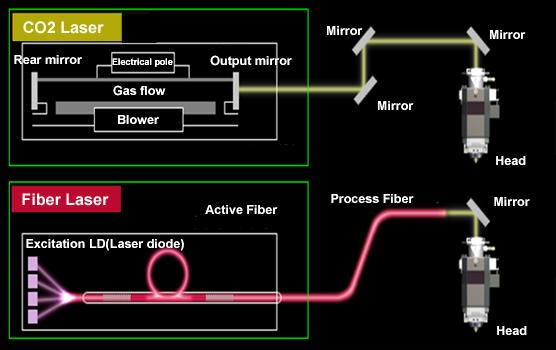
CO2 laser cutting for industry
The CO2 laser was one of the first gas lasers to be invented. It is based on a gas mixture held in a cavity, generally made of carbon dioxide (CO2), nitrogen (N2), hydrogen (H2) and helium (He).
It emits an infrared light beam with a main wavelength between 9.4 and 10.6 μm, suited to cutting carbon steel, stainless steel, PMMA and wood. It is a mature technology, but one that requires constant maintenance to stay stable.
Fiber laser cutting for industry
The fiber laser source is solid-state and needs no gas to generate the beam. Metal profiles are cut by transmitting the beam through a fiber connected to the cutting head: unlike CO2, there are no optical paths to align or maintain.
The short wavelength (1.064 μm) allows better absorption of the beam by the material and makes it possible to cut — besides carbon and stainless steel — also copper, brass and all aluminium alloys, which were excluded with CO2.
Being solid-state, the fiber laser is more stable than CO2 and the source requires no scheduled maintenance.
In which industrial sectors is laser cutting used?
Laser systems allow ever more precise work to high quality standards: over the years their scope has widened to cover almost every field where metal must be cut. Cutlite Penta systems suit, for example, 3D cutting of large-format metals. Some sectors:
- Automotive and railway
- Structural and aerospace engineering
- Oil & gas and shipbuilding
- Commercial vehicles and agricultural machinery
Laser cutting works iron, steel, stainless, aluminium, copper, brass, galvanized steel and titanium: a system the metal-processing industry can no longer do without, because it shapes materials with clean, precise cuts, free of burrs.
The same concentrated beam can be used for cutting, marking, engraving and welding hard, resistant metals — and also plastic and textiles — to create shaped parts in a short time for civil, military, naval and automotive engineering.
Wherever metal must be cut, today there is the laser.
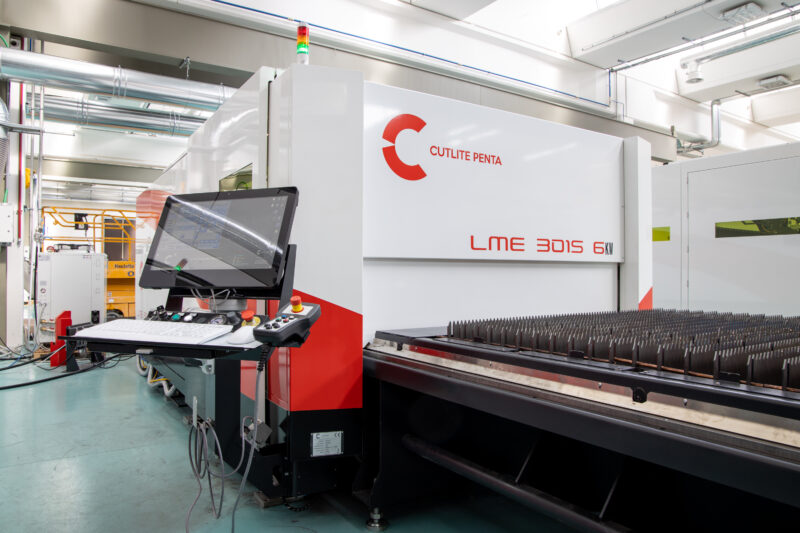
Cutlite Penta solutions for laser cutting in industry
The Cutlite Penta flat sheet-metal cutting machines, PLUS and LME, use linear motors. Compared with rack-and-pinion systems — cheaper to build but requiring more maintenance, less precise, noisier and less performing — linear motors offer a value for money clearly in the customer's favour.
The cutting head, developed and produced in-house by Cutlite Penta, works with lasers up to 20 kW and exploits high power with excellent results in cutting thick iron (20, 25, 30 and 40 mm).
The fluid-dynamics management engineered by Cutlite Penta allows a strong gas saving in high-pressure cutting, with nitrogen or compressed air: our systems cut 20 mm of stainless steel with just 15 bar of nitrogen.
Cutlite Penta is a manufacturer of complete laser systems: for the end customer this is an often-underestimated advantage. Discover the Cutlite Penta laser machines for industry.
Frequently asked questions about laser cutting for industry
How does industrial laser cutting work?
A lens focuses the beam onto the metal surface until it melts; a coaxial gas expels the molten material, creating the kerf. The path is guided by the CNC, with high precision.
Fiber or CO2 laser for industry, which is better?
The fiber laser is solid-state, with no lasing gases or optics to align, more stable and with no scheduled maintenance, and cuts copper, brass and aluminium too. CO2 remains suited to carbon steel, stainless, PMMA and wood.
In which sectors is laser cutting used?
Automotive and railway, structural and aerospace engineering, oil & gas, shipbuilding, commercial vehicles and agricultural machinery.
What power and thickness do Cutlite Penta lasers reach?
The in-house cutting head works up to 20 kW and cuts thick iron (20, 25, 30 and 40 mm).
Bring the Cutlite Penta laser into your industry
Tell us your materials, thicknesses and volumes: we will help you identify the laser system best suited to your industrial production.
