



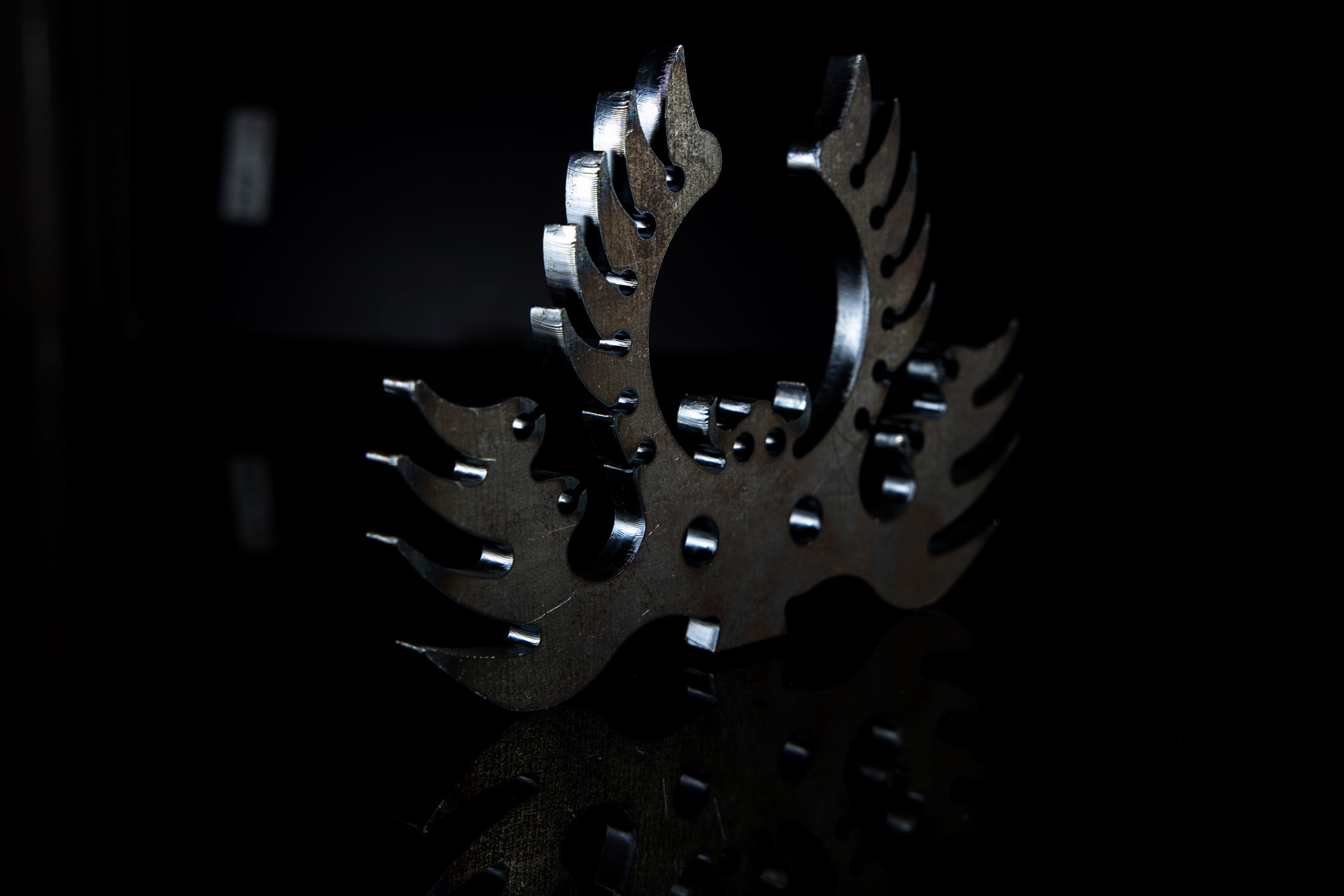
Metal cutting: what are the most effective methods?
Laser, waterjet, plasma, shearing. Four routes, one more effective than the rest.
Metal cutting can be done with four main technologies — laser, waterjet, plasma and shearing — but the laser is the most effective for precision, speed and versatility, thanks to its ability to concentrate an enormous light power into a tiny diameter.
Are all metal cutting techniques equally valid?
There are essentially four methods to cut metal:
- laser
- waterjet
- plasma
- shearing
The strength of the laser is its high ability to focus the working power onto a very narrow surface. This makes it the perfect technology for precision, quality work. Later we will see how speed is one of its strengths too.
At first glance the laser may seem the least economical solution, but considering speed, precision, cut quality and versatility it is by far the most effective technology for many types of metal cutting. Let's look at all the details.
In which sectors is laser metal cutting used?
The laser's application flexibility meets the many needs of every sector working with metal and its derivatives, in any shape.
Laser cutting is useful above all where precise dimensional performance is required. A low thermal impact is also a sought-after feature during cutting, and the laser delivers it.
That is why the laser beam is widely used in automotive and aerospace, but also in medical manufacturing, building and construction, displays and visual communication, specialized mechanics, flexible dies and engineering.
Using the laser to cut is different from using it to mark or engrave. Metal marking is typically used to label series products with their production features, or to apply serial, origin and traceability codes.
These are typical applications in the electrical and electronic industry, mechanical engineering and tool making, sheet metal processing, medical technology, promotional materials, jewellery and the automotive industry.
Not the cheapest to buy. The most effective: precision, speed, versatility.
Laser metal cutting: everything you need to know
Today laser technology is a widely used method for metal cutting. For every composition, alloy, thickness and consistency of metal there is a specific laser system suited to cutting. The great advantages of a laser cutting machine are:
- high precision
- speed
- versatility
Want to dig deeper? Contact us or ask one of our sales reps which laser machine best fits your metal cutting need.
Which laser source is best for cutting metal?
The market for laser cutting machines for sheet metal processing has developed rapidly in recent years.
New types of machines from different manufacturers have been introduced, revolutionizing the laser cutting process and, as a result, the choices available to companies and professionals. When it comes to sources, users today have two options, depending on their needs:
- the traditional sheet-metal laser cutting machines with a CO2 source
- the new-generation machines with a fiber laser source
CO2 laser source
The traditional CO2 laser was long the most widespread source. Its first applications on sheet metal date back to the late 1980s and, until a few years ago, were recommended for supports thicker than 4-5 mm.
This type of source uses a gas mixture — the so-called lasing gases — and a lot of electrical current to generate the light beam. Given the high operating temperatures, a substantial cooling unit (chiller) is needed.
These sources have a low energy efficiency (no higher than 10-12%): for every kW available for cutting, about ten times as much is needed for the laser device alone. Until 2007 this was the only type of laser available for cutting.
Fiber laser source
In the following years the market began moving toward new technologies: fiber sources. They use optical fibers "pumped" with diodes to create solid-state cutting sources, with far fewer components and no lasing gas. The key factor in choosing the machine is efficiency.
The rapid development of fiber sources is due to their higher production speeds, greater precision and significant cost-saving advantages.
Fiber laser sources have a better focusing capability, are far more stable and the spot diameter is much smaller than a CO2 source: the cut is therefore more precise and stable during processing.
The energy efficiency of a fiber source is today on average 35% higher than CO2. There are no costs for lasing gases, no mechanical parts that wear out and fiber sources need no maintenance.
About ten years ago, anyone cutting thicknesses above 4-5 mm had to choose a machine with a CO2 source: fiber source power rarely exceeded 2-3 kW. Today, thanks to technological developments, fiber sources are available with power above 15 kW.
Fiber sources have essentially replaced CO2 lasers in all metal cutting applications. CO2 sources remain valid instead for cutting non-metal materials such as wood, plastic and textiles.
Frequently asked questions about metal cutting
What are the methods for cutting metal?
There are four main ones: laser, waterjet, plasma and shearing. The laser is the most effective for precision, speed and versatility.
Why is the laser the most effective method?
Because it concentrates an enormous power onto a very narrow surface: it ensures precision, speed, versatility and a low thermal impact during cutting.
CO2 or fiber laser source, which is better?
For metal cutting the fiber source has by now replaced CO2: a smaller spot, greater precision, no lasing gas, less maintenance and power above 15 kW. CO2 remains valid for non-metal materials.
Is the CO2 laser still useful?
Yes: CO2 sources remain valid for cutting non-metal materials such as wood, plastic and textiles.
Find the right laser system for your metals
Tell us what you need to cut: we will help you identify the source and laser machine best suited to your materials, thicknesses and volumes.
