


Laser cutting plastic: 3 outstanding systems for acrylic
Not every plastic can be laser cut. Acrylic can, and it is what the laser does best.
Laser cutting of plastic lets you cut, engrave and mark polymer materials with a CO2 laser source. On acrylic (PMMA) it is at its best: clean edges, no burrs and no mechanical contact. Here is what to know, plus the three dedicated Cutlite Penta systems.
What do we mean by plastic in laser cutting?
Cutting plastic, with or without a laser, is a rather vague statement: the term plastic covers a wide range of materials, also called non-metals.
Plastic is an organic material with a high molecular weight, made of pure polymers or blended with various additives and fillers. The most common polymers come from petroleum, but there are also plastics obtained from other sources.
The IUPAC (International Union of Pure and Applied Chemistry) itself recommends the term polymers instead of the generic plastic. In everyday use, however, we call plastic most of the polymer materials that contain substances able to modify their chemical and physical properties.
When can plastic be laser cut?
Not all plastics behave the same way. Pure polymer materials fall into three families:
- Thermoplastics: they become malleable with heat, can be shaped and then set by cooling; a process that can be repeated several times.
- Thermosets: after an initial softening they harden through cross-linking; if reheated after hardening they do not become malleable again, but decompose and char.
- Elastomers: they show high deformability and elasticity.
Almost all plastics can be processed with laser cutting, engraving and marking. One of the most widespread materials is polymethyl methacrylate, known as PMMA, acrylic or plexiglass.
PMMA is a transparent, rigid, shatterproof and UV-resistant plastic, belonging to the thermoplastics. It has extraordinary transparency, higher than glass, with a coefficient of about 0.93: this is why it is also used for protective barriers in stadium stands. Acrylic sheets resist impact well; a 4 mm sheet reaches a strength of 12 Joules, which justifies its use for outdoor canopies and shelters.
Which type of plastic can be laser cut?
Plastics are malleable organic materials that can be extruded into sheets or moulded into complex shapes. The variety is wide: from raw plastics such as acrylic and ABS to engineering plastics such as polycarbonate and acetal.
Some materials lend themselves better than others. Acrylic (plexiglass, PMMA) is among the best: as a rule, thermoplastics such as plexiglass are the easiest to laser cut.
Plexiglass has unique physical properties, so much so that it is often preferred to glass. It shapes with heat and is ideal for cutting and engraving with a CO2 laser. The laser cuts both extruded and cast PMMA: extruded PMMA has tighter thickness tolerances, while cast PMMA delivers perfect cut edges and high-contrast engravings.
In which sectors is acrylic laser cutting used?
The first PMMA acrylic sheet was produced in 1936 by ICI Acrylics (now Perspex International), one of the world's largest PMMA sheet manufacturers. The first sheets were used for the canopies of Second World War fighter aircraft.
Since then, acrylic has spread across retail, design and indoor and outdoor furnishing, the medical and scientific sector, advertising, communication and entertainment. More recently it has entered objects and furnishing for automotive, yachts and boats, offices and construction.
Plexiglass pairs perfectly with laser cutting thanks to its chemical and mechanical properties: weather and UV resistance on one side, a high level of fire safety on the other. All of this makes PMMA a highly workable material that is easy to laser cut.
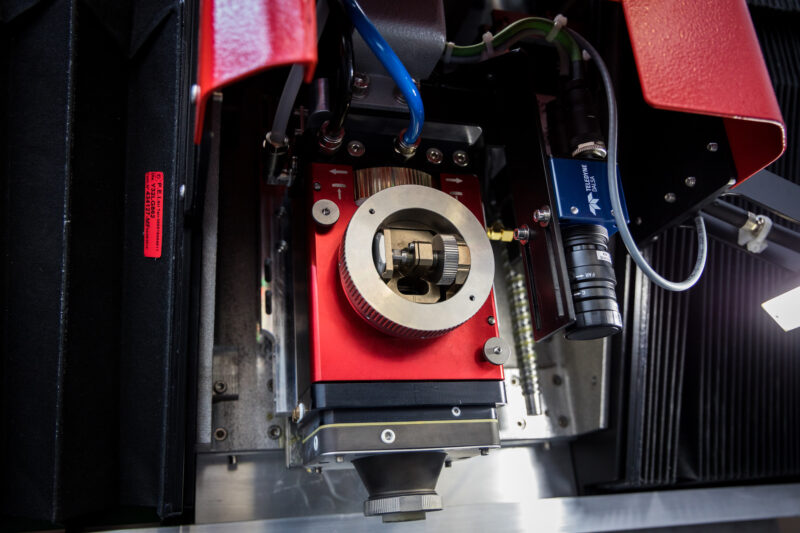
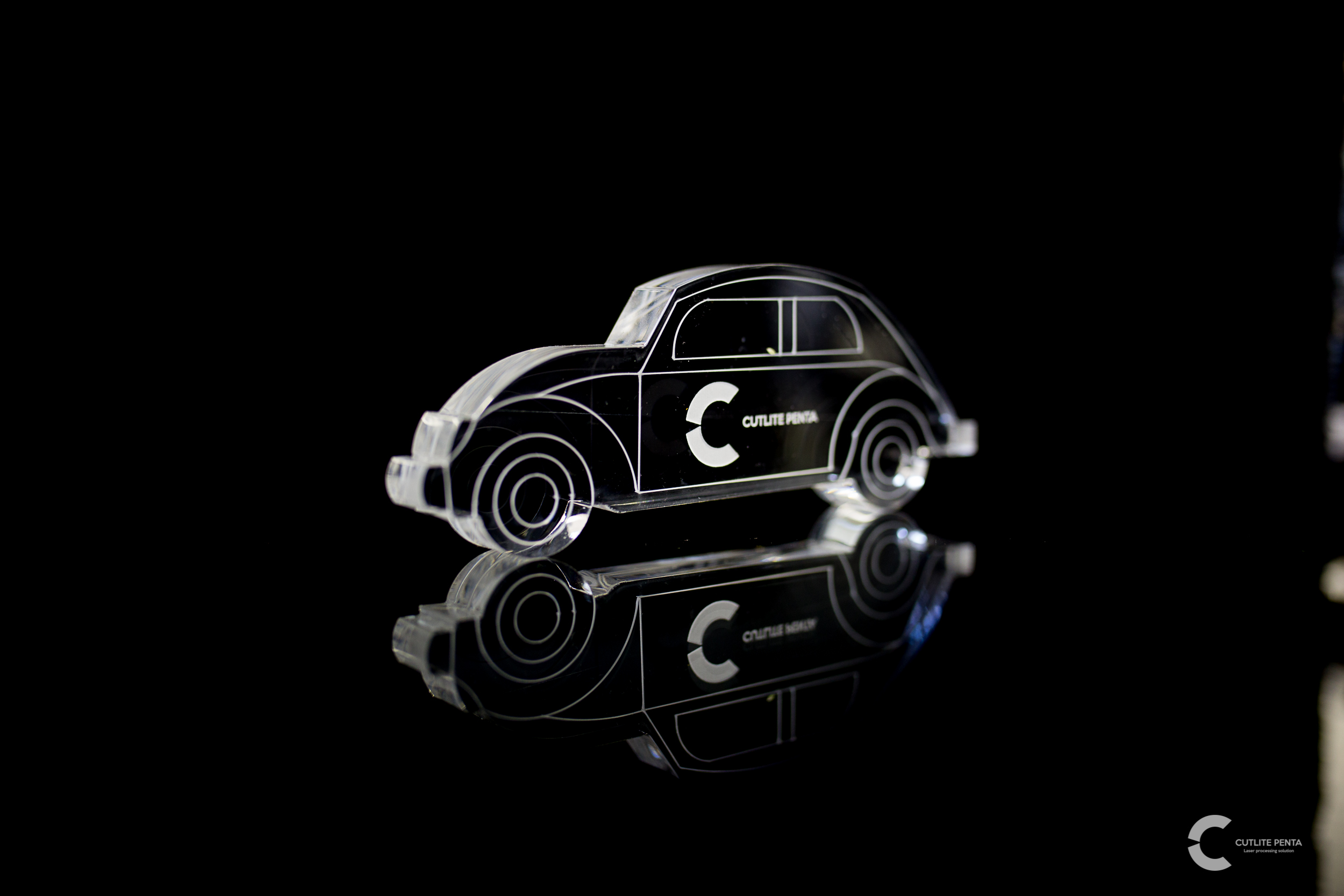
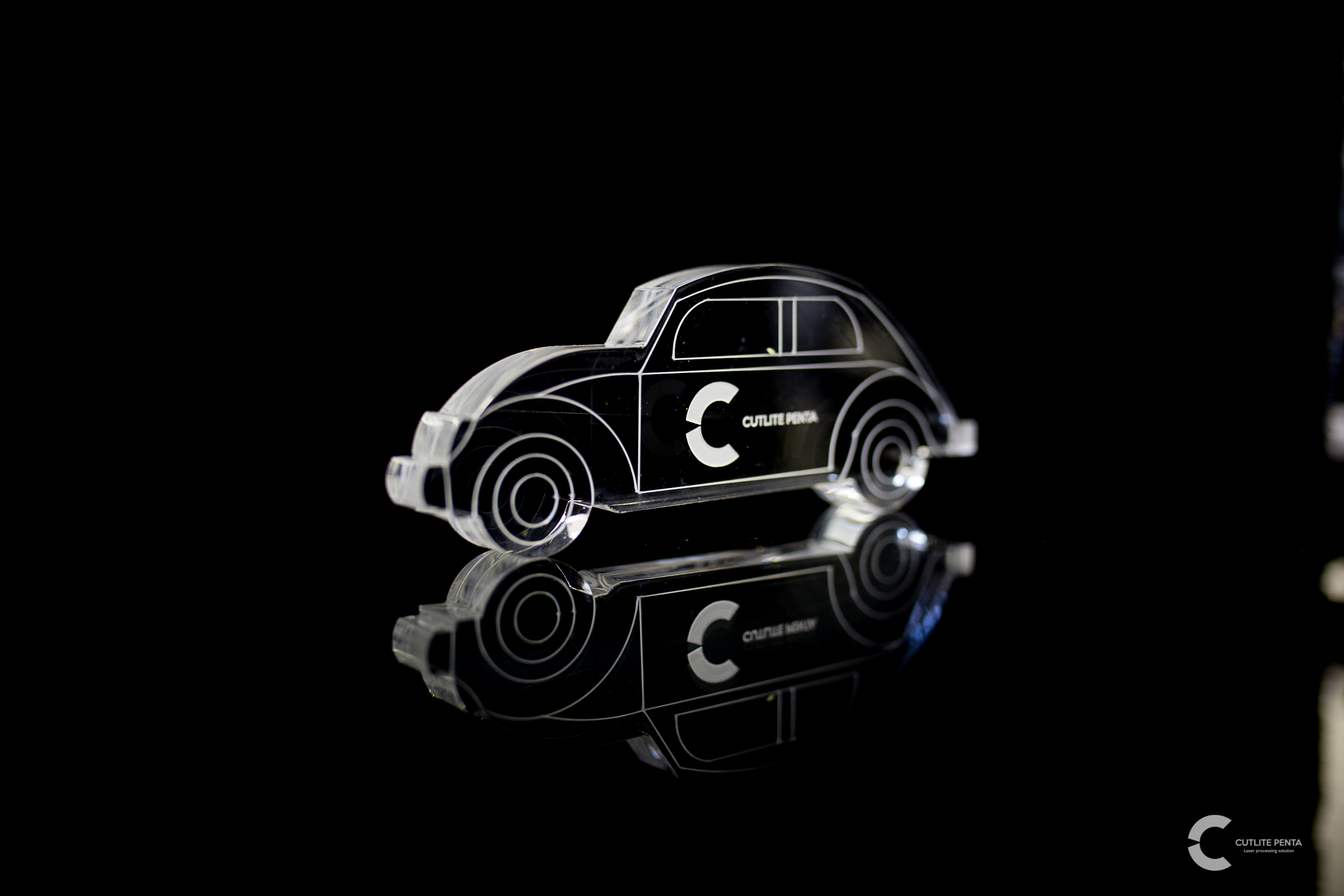
On acrylic, the laser does what other methods cannot: clean edges, zero contact, zero burrs.
Which type of laser is used to cut plastic?
The introduction of the laser opened the way to new processes and market solutions: the convenience and speed of cutting systems have made processing plastic far more cost-effective than traditional methods. Most of the more common polymers are perfectly compatible with the CO2 laser. Choosing the right system, however, is not that simple: several variables come into play.
- the type of application
- the type of plastic to be cut
- the production requirements
The CO2 laser is one of the most widely used technologies in industry: flexible and powerful, it is fitted to most of the machines used across the most varied sectors. The robustness of CO2 sources also holds true when cutting plastic supports, sheets and surfaces.
What is the strength of a CO2 source for plastic? In general, it ensures thousands of hours of high-quality operation. Let us look at the main benefits in detail.
What are the advantages of laser cutting plastic?
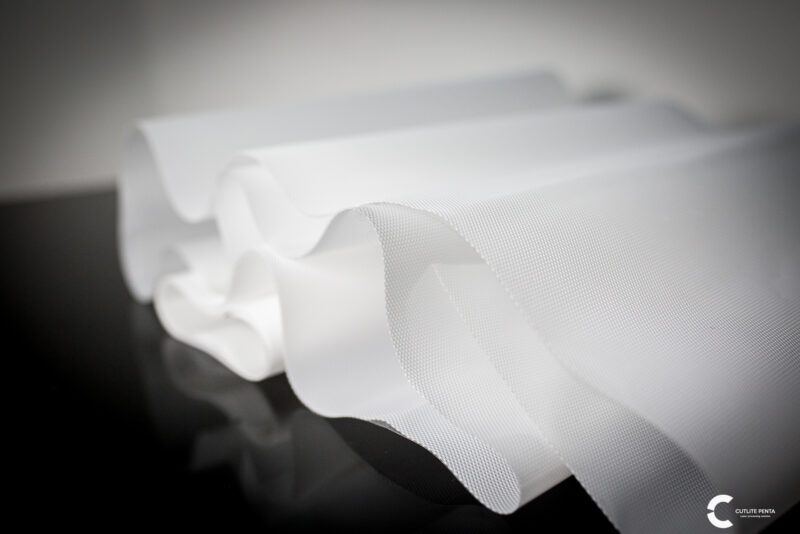
The toughness of plastic would require long, repetitive cutting methods to obtain a smooth, regular result in series. With the laser, the process is optimized.
1. Savings on costs and raw material
The laser instantly vaporizes the surface area it acts on: no chips or machining waste and no risk of deforming the part.
2. Excellent cut quality
The precision of the machine ensures clean cuts, perfectly traced corners and no burrs, with no need for finishing or touch-ups. Cutting happens with no contact between the parts: it brings the deformation and accidental breakage typical of traditional methods to zero.
3. Series repeatability with reduced consumption and maintenance
The parts come out uniform and identical to one another. The laser is managed digitally by software, so its movements are exact and the operator's settings are executed precisely, with very low gas consumption and reduced source maintenance.
The 3 Cutlite Penta laser systems for plastic and acrylic
Cutlite Penta laser systems are perfect for cutting plastic. Depending on the processing needs, the range dedicated to plastic and acrylic components is built around three solutions:
- PLUS CP RF: the ideal tool for laser cutting PMMA and acrylic material.
- LMP: it keeps the linear-motor architecture, with the option to design and program plastic processing on board the machine.
- LTS CP RF: it allows the radio-frequency CO2 laser source to be mounted on board the machine, for an even more compact footprint.
Cut quality, performance efficiency and contained consumption are within reach with the Cutlite Penta machines for plastic and acrylic processing.
Frequently asked questions about laser cutting plastic
Which plastics can be laser cut?
Almost all plastics can be cut, engraved and marked with a laser. Thermoplastics work best, in particular acrylic (PMMA or plexiglass).
Which laser is used to cut acrylic?
The CO2 laser is used, the most widespread industrial technology for plastic: it cuts both extruded and cast PMMA, with clean edges and high-contrast engravings.
Does laser cutting plastic leave burrs?
No. Cutting happens with no mechanical contact and vaporizes the material: you get clean edges and precise corners, with no chips and no need for finishing.
Which Cutlite Penta systems cut plastic?
Cutlite Penta offers three dedicated systems: PLUS CP RF for PMMA and acrylic, LMP with linear motors and on-board programming, and LTS CP RF with an on-board radio-frequency CO2 source for a more compact footprint.
Cut plastic and acrylic with the Cutlite Penta laser
Tell us about your work on acrylic or other polymers: we will help you choose the CO2 laser system best suited to your materials, formats and volumes.
