


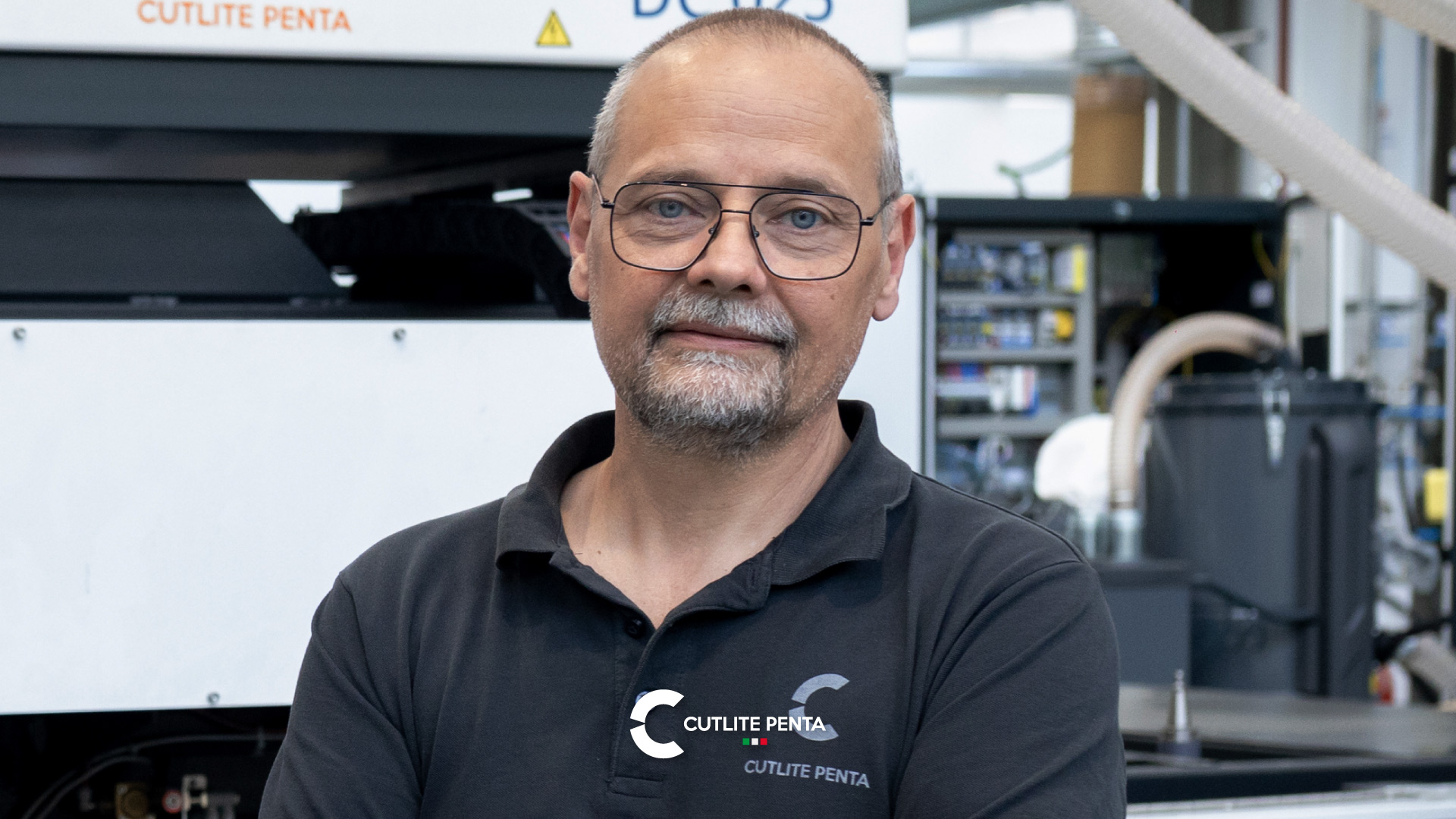
CO2 laser and cutting dies: an interview with Gianni Berlincioni, employee number 1
Almost 33 years at Cutlite Penta, starting back when there were five of them and everyone did everything. Gianni Berlincioni is employee number 1, and his specialty is the CO2 laser and cutting dies.
Before the metal cutting machines there was the CO2 laser, and with it the world of diemaking: a niche sector Cutlite Penta has always worked in. We talked it through with Gianni Berlincioni, who watched that sector take shape from the inside.
From five people to a company that sells worldwide
“At the start there were five or six of us at Cutlite Penta and we all did everything: building the machine, delivering it to the customer, service. As the company grew, the offices and departments split up and took shape, and everyone's role got defined.”
In the early days Cutlite Penta only built CO2 laser machines for cutting dies and plastics, and that is the market where it made its name in Europe and beyond. Then the market grew, and the company with it, moving into fiber laser.
“Potential customers split into those who had a laser and those who did not. The second group worked with a handsaw. Moving to laser meant speeding up the process and cutting costs dramatically.”
Over those years Gianni contributed to the development of the CO2 machines and of the diemaking side, which is still a specialty of the company today.
What a cutting die is
A cutting die is the tool used to make a cardboard box. It is a plywood board in which the laser cuts thin, highly precise slots: into them go the metal steel rules that cut and, where the cardboard has to fold, the creasing rules, which are lower and not sharp. The sheet of cardboard is then either cut or creased depending on the position.
Cutting dies are used to make boxes in printing and paper converting, but also in leather goods, the textile industry and other sectors. Once the die is ready it is mounted on the die-cutting press: the material goes in and, with one sharp stroke of the machine, the customer gets the shape of the die.
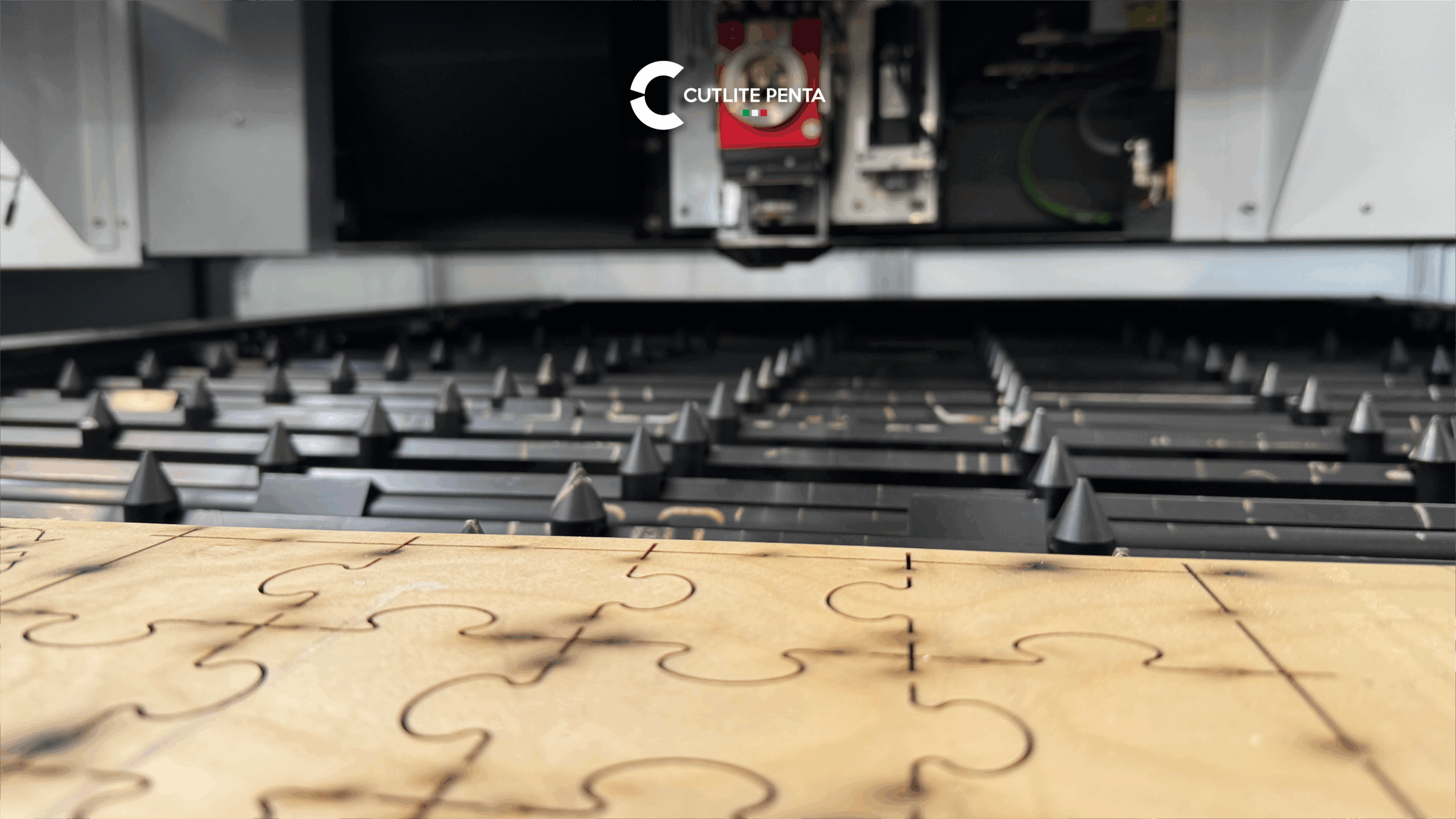
Making a die properly means getting the slot exactly right where the rule goes in. Too wide, and the rule can stick to the material and pull out during the job; too narrow, and the wood can warp, lose its dimension and even split. This is where the probe comes in.
“The essential thing is consistency of cut: it has to be the same from the start of the board to the end. Wood is an extremely unpredictable material, it can be softer or harder, it can warp, it is never completely uniform. The probe picks up the variations in the board and keeps the laser beam always at the same distance, raising or lowering the cutting head as needed.”
How a CO2 laser works, and what it cuts that fiber cannot
A laser machine has a source of coherent, unidirectional, monochromatic light. The beam is guided to the workpiece by a series of mirrors set along the beam path. Inside the cutting head there is a sealed section holding the focusing optics: only clean, dried and filtered air gets in there, because a single particle in the beam path degrades it and distorts the result.
On Cutlite Penta machines the cutting head has always been built in-house, updated and improved year after year.
The difference between the two lasers is wavelength. The CO2 wavelength is absorbed by wood, plastic and ceramics, which is why it cuts them: a fiber laser does not work on those materials. Conversely there are metals the CO2 struggles with, in particular copper and brass and above all on thick material, and that is where fiber laser solves the problem. It is not a contest between the two: they are two tools for different materials.
Maintenance: cleaning, extraction, greasing
“Keeping the machine clean is the basis of it running well. Extraction matters enormously, because it is the fumes that dirty the machine, the optics, and slow it down by sticking to everything. And greasing the systems that need lubricating is essential too.” Three things, in practice:
- Regular cleaning: it is the basis, and no automation replaces it.
- Fume extraction: fumes stick to everything, optics included, and slow the machine down.
- Greasing the systems that need lubricating.
Cutlite Penta machines can be fitted with an automatic greasing system (CP Grease). It helps a lot, but it does not remove the need for regular cleaning: that stays with whoever runs the machine.
“On average response times for a machine down, we try to act straight away, getting there in around 24 hours depending on the location. Long enough to load the van, and we are off.”
The diemaking market and the plastics market
“The diemaking market is fairly static, a niche, and almost every die maker worldwide has a Cutlite Penta machine. These machines last many years, they are well built and they do not have to run extremely fast. That is why they can last twenty or twenty-five years and need little maintenance.”
“The plastics market, on the other hand, has really boomed, above all since we started building machines with linear motors.”
“That is why we put as much care as we possibly can into our machines. On the CO2 side especially, the companies all know each other, and one small slip on our part could ruin the reputation we have built over all these years.” It is the reason a niche division still gets the same attention as the others.
Frequently asked questions
What is a cutting die?
It is the tool used to cut and fold cardboard into a box. It is a plywood board in which the laser cuts thin, precise slots: into them go the steel rules that cut and the creasing rules, which are lower and not sharp, to create the folds.
Why is a CO2 laser used for cutting dies instead of a fiber laser?
Because of the wavelength. The CO2 wavelength is absorbed by wood, plastic and ceramics, so it cuts them; the fiber laser wavelength is not. Conversely, fiber works well on metals such as copper and brass, which CO2 struggles with, especially on thick material.
What is the probe for on a diemaking machine?
It keeps the distance between the cutting head and the wood constant. Wood is not uniform and can warp: the probe picks up variations in the board and raises or lowers the head, so the slot stays identical from start to finish.
How long does a CO2 laser machine for cutting dies last?
According to Gianni Berlincioni, twenty to twenty-five years with little maintenance: these machines do not have to run at extreme speeds and, kept clean and greased, they stay in production for decades.
Find the right laser system for your material
Wood, plastic, cardboard or metal: tell us what you work with and we'll help you work out which laser technology fits.
