


Four plasma torches against one 40 kW laser: why Iron SpA chose the PLUS 6025
Iron SpA is a sheet metal service center in Assisi, Umbria. It already has two laser machines, a CO₂ and a 10 kW fiber, and still runs plasma and oxyfuel. It has bought a 40 kW PLUS 6025 with automatic storage, and in September it ran the running test at our plant.
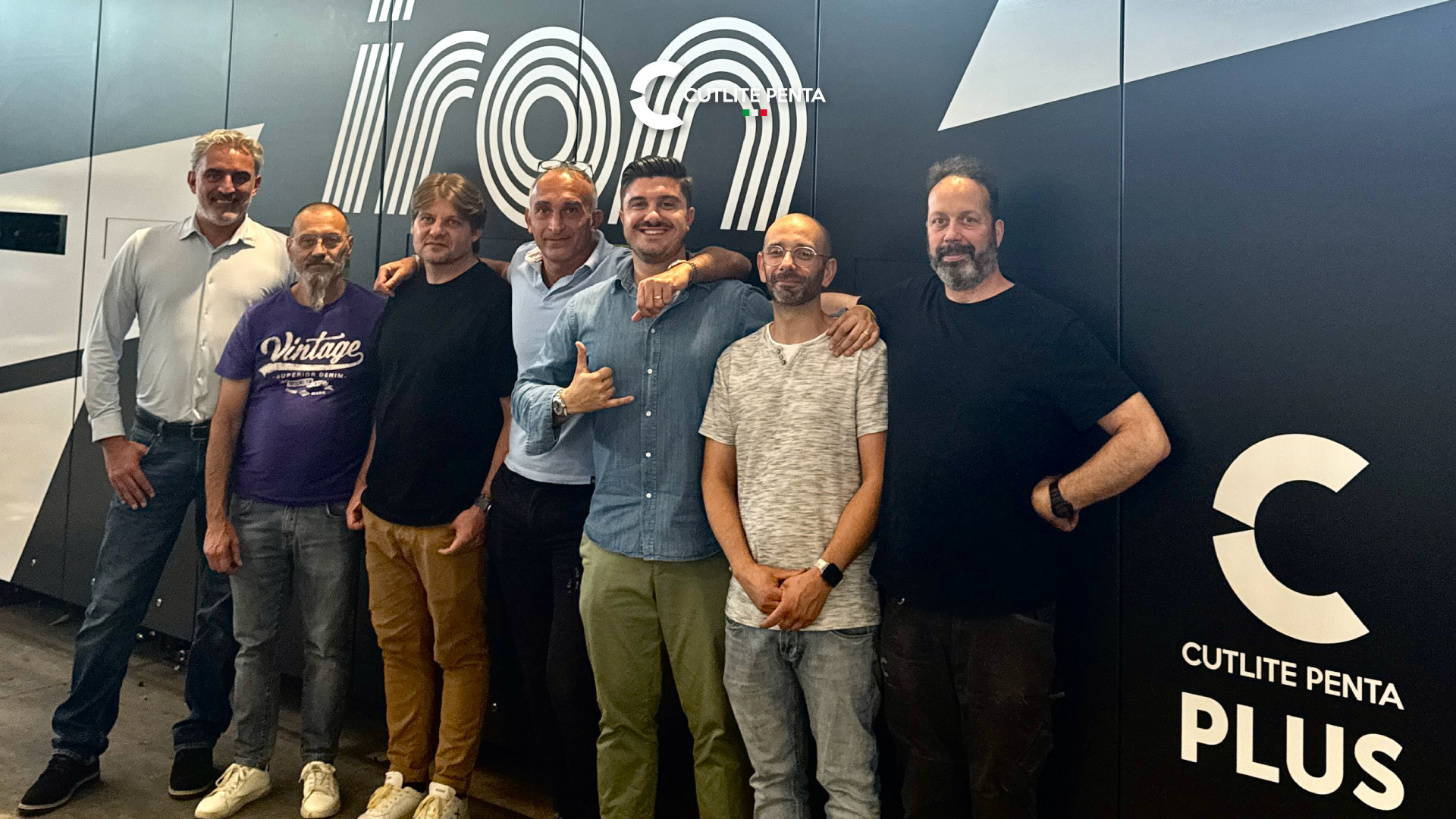
We discussed it with Massimiliano Semprini (plant and engineering manager), Lucio Ciambrusco (production manager) and Antonio Autieri (cutting machine operator, fifteen years on plasma and five on laser). One thing to keep in mind while reading the numbers: the machine has been tested, not yet installed, so the performance they describe are targets verified in trials, not production results.
Who Iron SpA is
Three areas: levelled sheet, pre-processing, tubes
“Iron SpA is a sheet metal service center split into three areas”, Massimiliano explains. “Our core business is levelled sheet, with three levelling lines handling thicknesses up to 20 mm. Then there is pre-processing, for which we have a complete set of technologies: laser, oxyfuel, plasma, along with shears, deburring machines, grinders, shot blasting and press brakes up to 14 meters. Finally tube work, with large diameter tubes and plate rolling.”
Where they are and who they work for
“We are in central Italy, in Umbria, and from here we serve the whole country and beyond, covering the entire steel chain: from coil levelling to cut-to-size sheet, through to the most complex pre-processing”, Lucio adds. The Italian market is worth about 90% of turnover.
“Our main customers are generally companies that own laser systems themselves and further process our products”, Antonio points out. “We offer both the finished product and the raw material, adapting to each customer's needs.” That detail matters: when your customer has a laser in house, your cut is judged by someone who knows exactly how it is done.
Why a new machine, if they already had a fiber laser
What the 10 kW fiber could not do
“Our current laser is larger, with a 14 meter dual table, but it did not let us be competitive in terms of power, especially on heavy plate, where market demand is very high”, Massimiliano explains. “The speed was no longer adequate for that market.”
“The choice came from needing a technology faster than what we have now”, Antonio adds. “The Gas Mix and the cutting head on this machine, together, produce a kind of piercing that optimizes the process a lot.”
The automatic storage, and the night shift
“Above all, what was missing was the automatic storage tower, which would have let us keep the machine running at night as well.” That is the second reason for the purchase, and it weighs as much as the power: an extra shift without extra staff.
“We bought the first laser when this technology first appeared on the market, retiring some old plasma machines. We did not want to be left out of fiber laser, but now it is time for the next step. We keep plasma and oxyfuel to cover the widest possible range of requests.”
How they got to Cutlite Penta
“We were struck by the number of machines sold in previous years”, says Massimiliano. “And by the value for money of Cutlite Penta machines.”
“Value for money was decisive, but just as important was the personal relationship with Alessio Venturini, Sales Area Manager for Lombardy and Emilia Romagna”, Lucio says. “We already knew Alessio and went to him for advice on which machine suited us best. The following meeting with Delio Mugnaioni, our managing director, confirmed the choice: we found a good compromise between power, quality and size.”
“I was convinced fiber could not replace plasma above 20 mm”
It is the objection we hear most often, and Lucio had it too. “Until now I was convinced a fiber laser could not replace plasma above 20 mm. But the power levels reached today, 40, 50 and 60 kW, made me change my mind: I saw with my own eyes that you can cut parts of 40 to 50 mm.”
Four plasma torches against one laser head
Here comes the calculation that makes the story interesting, and it is not about cut quality: it is shop floor arithmetic.
“Our plasma machines have four torches: we needed a machine four times faster to replace them. With these numbers it became not just possible, but worthwhile.”
What someone with fifteen years on plasma says
“I worked fifteen years as a plasma operator before moving to laser”, Antonio says. “With laser you get a cleaner, more accurate product, while plasma has technical limits that stay, like the bevelled edge caused by the conical flow of the jet. With laser you reach tenth of a millimeter tolerances, with plasma you talk in millimeters. For rougher work plasma is still useful, but if the finished part has to be accurate it is not the right technology.”
The speed difference on 15 mm
“There is no comparison. On 15 mm plate, with this PLUS we expect to reach 9 m/min of linear speed, while with plasma we are at 3.3 m/min: almost three times. On long jobs the difference is substantial.”
Which thicknesses they work on
“It depends. We have oxyfuel that goes to 300 mm, the laser from 2 to 20 mm and plasma cutting up to 40 mm”, Antonio lists.
“With the new laser we will cover everything within 6 meters of length and thicknesses up to 35 mm”, Massimiliano specifies. “For thicker material oxyfuel and plasma remain. Our main market is between 6 and 35 mm, mostly heavy plate.”
“What interests us is the middle range of thicknesses, from 8 to 10 mm up to 30 to 35 mm”, Lucio concludes. “We are not looking for quality above 50 mm, but for speed on medium thicknesses, and we know we can get it with this 40 kW system.” It is an unusually precise definition of the goal, and it explains why the choice did not fall on the highest power available.
How the relationship went during the purchase
“The sales phase was excellent, with a lot of availability from the Cutlite Penta team. After signing the contract we had some communication difficulties around timing and technical details, but we are confident about the machine we bought and about how it can optimize our production processes. What matters is constructive dialogue to improve the process.”
The running test, thickness by thickness
“We are systematically testing everything, from the simplest jobs to the most complicated”, Antonio explains. “Alessio gave us a table of the maximum thicknesses the machine can cut. Can it cut 50 mm? Yes, we tested it. We are also trying 35 mm in Gas Mix, which allows higher speeds than cutting with oxygen alone.”
Holes: the detail that comes back in every job
“We pay close attention to hole quality across the different thicknesses. Working in any sector, from a small plate to parts for building the side of a ship, holes can be critical for screwing or bolting plates together. It comes up constantly, so they have to be made as accurately as possible.”
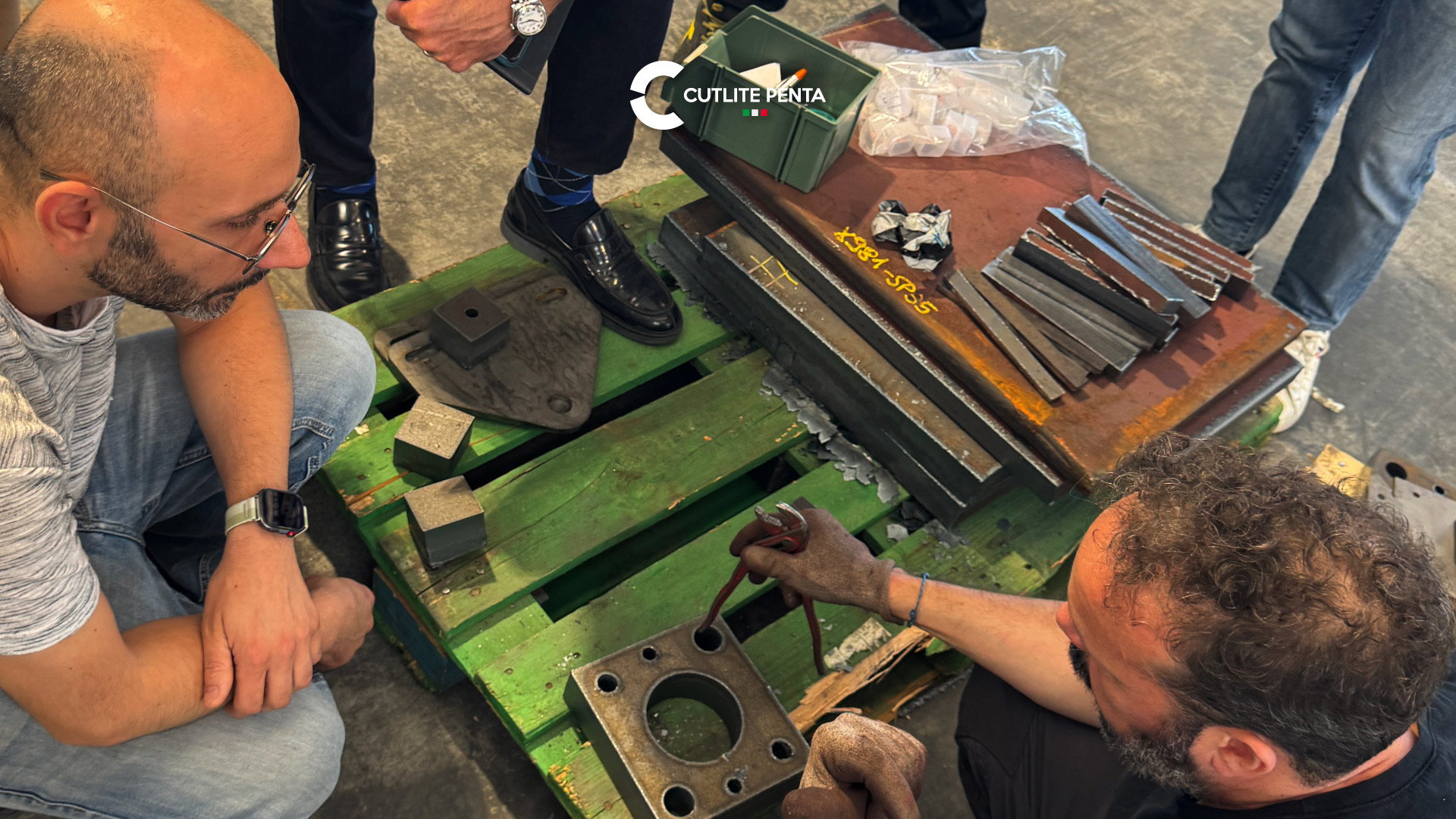
“We are running various trials to have it ready to use”, Lucio adds. “The real commissioning we will do at our plant, once all the thicknesses are set up.”
The software: you can do a great deal, but you have to know how
It is the most honest answer in the interview, and it is worth quoting in full. “What struck me is the software on board”, Antonio says. “It lets you do a great many things compared with what we have on the other machine, but at the same time it is more complicated to use, because the other one has a more basic interface. I am convinced that once we learn to use all of its potential we will have an edge.”
“Everything is unlocked and editable by the end user. You can do a great many things, but you have to be able to do them.”
“The guys on my team will need training to make the most of the amount of data the machine offers.” That is a request, not a complaint, and it concerns the moment a machine goes from installed to productive. The PLUS series is built for high power on medium to heavy thicknesses: how much of that power ends up in the part depends on whoever programs it.
Frequently asked questions
Can a high-power fiber laser replace plasma cutting above 20 mm?
It is the question the production manager at Iron SpA asked himself, and he was convinced of the opposite. With 40, 50 and 60 kW he verified cutting on 40 to 50 mm parts in trials. The real calculation, though, is not about maximum thickness: their plasma machines have four torches, so the laser has to be roughly four times faster to replace them, and that is what makes the operation worthwhile.
How much faster is a 40 kW laser than plasma on 15 mm?
In the running test carried out by Iron SpA, the 40 kW PLUS 6025 targets 9 m/min of linear speed on 15 mm plate, against 3.3 m/min from their plasma machines: almost three times. The figure comes from acceptance trials, not from continuous production.
What is an automatic storage tower for on a laser machine?
It feeds the machine without an operator, so it can run at night too. For Iron SpA it was one of the two reasons for buying, along with power: the laser they had, although larger, had no storage tower and therefore stopped at the end of the shift.
What difference does Gas Mix make compared with cutting in oxygen?
It allows higher speeds on medium thicknesses. Iron SpA is trying 35 mm in Gas Mix for exactly that reason, and points to Gas Mix together with the cutting head as the combination that changes piercing behavior.
Do you have a multi-torch plasma to replace?
Tell us how many torches you run, on what thicknesses and at what speed: the comparison is made on your numbers, not ours.
