


From Europe's first 30 kW laser to today's 60 kW: how we got here
October 2022, Hannover. We brought a 30 kW fiber laser to Euroblech, when almost everyone else stopped between 8 and 12 kW. Four years on, the same range reaches 60 kW, and by the end of 2026 the installed systems will number around a hundred.
This page is the timeline of that route, with the dates and the numbers, and no adjectives. It is for anyone weighing an investment who wants to know how long we have been doing this, not how much we enjoy talking about it.
October 2022, Euroblech: 30 kW on the stand
From 25 to 28 October 2022 we took a 30 kW PLUS system to Hannover, to the 26th Euroblech, together with an 8 kW LME. That announcement is still online. At the time most builders were offering sources between 8 and 12 kW: 30 kW was not a range update, it was a different scale.
We were a small company next to the historic names of the sector, and we did not know where it would take us. There was one goal: to install the first 30 kW in Europe. That part we did.
Why 30 kW was not simply double
Above a certain power the machine is not updated, it is redesigned. What changes is not the number on the plate, it is the components that have to take it:
- the cutting head and the optics, which work under different conditions at these powers
- the assist gas, with pressures and flows that become a heavy cost item
- the fume extractor, sized on the real process
- the thermal management of source and machine, which decides stability over time
That is why we design the cutting head in house: at 30 kW there were no catalogue heads doing what we needed. Today's Evo 4, rated to 60 kW and 25 bar, comes out of that necessity.
The ladder, year by year
Since 2022 the range has climbed in steps, and every step was a real installation before it was a product:
- 2022: the first 30 kW, shown at Euroblech and installed in Europe
- then the first 40 kW
- then the first 50 kW
- today the 60 kW, with the in-house Evo 4 cutting head
It was not a roadmap decided in a meeting room. Each power arrived when a customer was willing to put it into production, which is a slow way to grow but the only one that leaves working machines behind it.
Every step up in power was a real installation first, and a catalogue product only afterwards.
Where we are today: the numbers
By the end of 2026 we will reach around 100 installed high-power laser systems, across 30, 40, 50 and 60 kW, spread between Europe and the Americas. That number says more than any description: it counts how many times we have put these powers into production, not how many times we have described them.
It matters to us as much as to the reader: a hundred installations are a hundred different combinations of materials, thicknesses, gases and automation. That is why, when you arrive with your drawings, the answer is not a brochure.
80 mm, with a 4 mm pierce
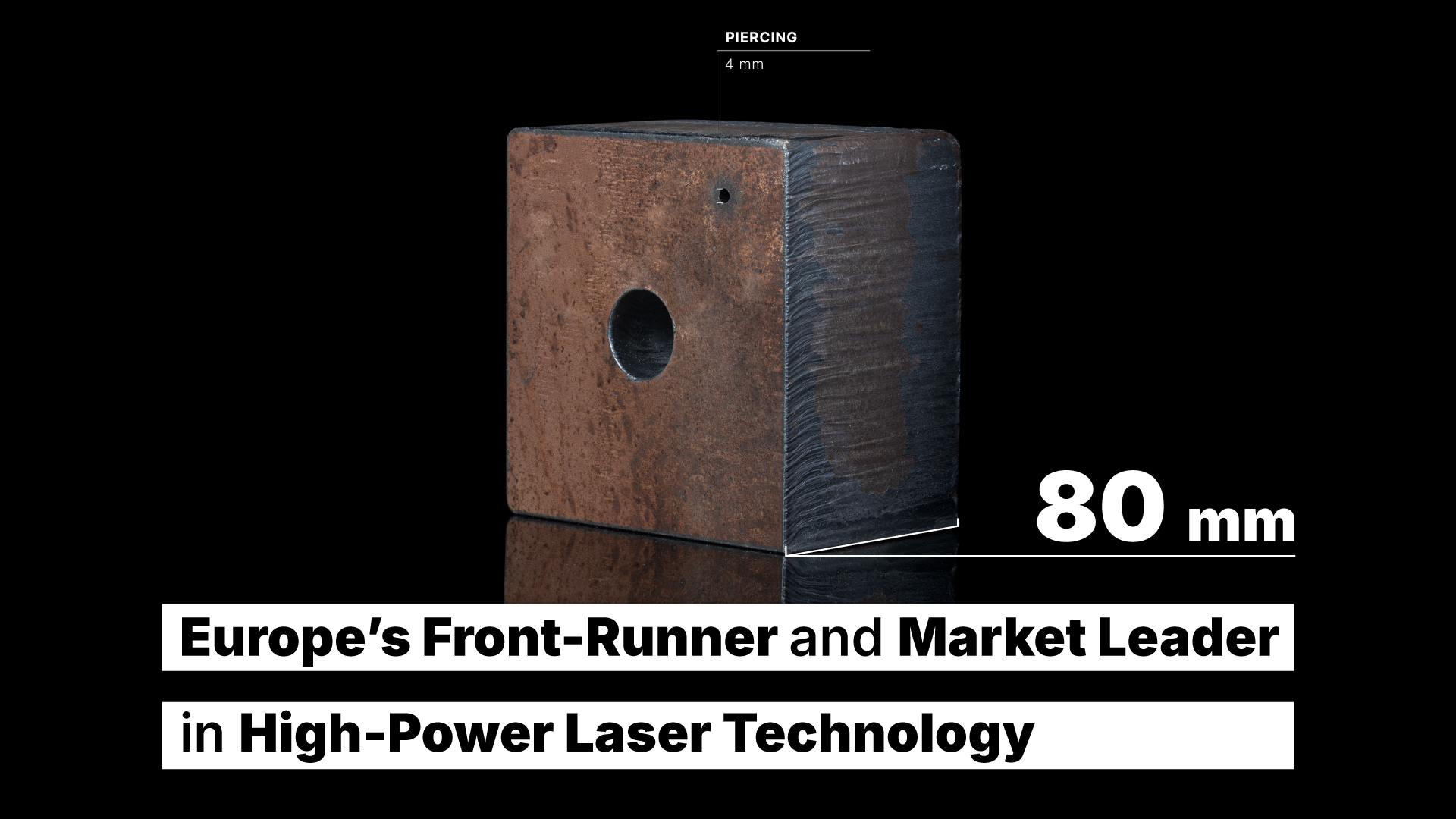
The part in the cover image is a block of steel 80 mm thick, cut by laser. The small hole at the top is the pierce, and it measures 4 mm.
Those are the two numbers that say most about high power. The thickness shows how far the process reaches. The pierce diameter shows how concentrated the energy is: on material that thick, opening the entry hole in 4 mm means the beam is not heating everything around it.
On the cut face you can see the vertical lines typical of heavy plate. It is a DEMO-area part, not a simulation: these are the parts we cut in front of the customer, on their own material when they bring it.
The comparison with plasma, without overstating it
At 30 kW we already matched plasma speeds on several jobs, and with the powers that followed the margin widened. But the comparison has to be made in full, not only where it suits us:
- the laser gives a clean edge and a narrow cut, and on many parts it removes secondary operations
- the process is enclosed in a cabin, so the operator is not inside the working area: it is a Class 1 laser apparatus
- the laser produces fumes and needs extraction, like any thermal cutting: the extractor is part of the system
- above 150 or 200 mm and on oversized formats oxyfuel cutting remains cheaper, and several of our customers keep a plasma machine for bevel cutting on large formats
Anyone telling you the laser has made everything else pointless is selling you something. We wrote a whole page on that question, with the conditions under which plasma remains the right choice.
Frequently asked questions
When was Europe's first 30 kW laser shown?
In October 2022, at Euroblech in Hannover, where Cutlite Penta brought a 30 kW PLUS system together with an 8 kW LME. At that time most builders were offering sources between 8 and 12 kW.
How many high-power machines has Cutlite Penta installed?
By the end of 2026 there will be around 100 systems rated 30, 40, 50 and 60 kW, installed across Europe and the Americas. That installed base is the foundation of how we configure systems, set cutting parameters and support these powers technically.
What is the maximum thickness a high-power laser cuts?
It depends on material, required finish and gas, so there is no single figure. As a concrete reference: the part in the image on this page is 80 mm steel cut by laser, with a 4 mm pierce. Above certain thicknesses and on very large formats oxyfuel cutting remains cheaper.
Can a high-power laser replace plasma?
On many jobs yes: plasma speeds were already matched at 30 kW, and at higher powers the laser adds a clean edge, a narrow cut and fewer secondary operations. Not on every job, though: beyond a certain size and thickness oxyfuel cutting costs less, and for bevel cutting on large formats several companies still keep a plasma machine.
How much power do you actually need?
Bring us the material, thicknesses and tolerances of your parts: cutting gets tested in our DEMO area in Prato. And the answer is not always the highest power.
