



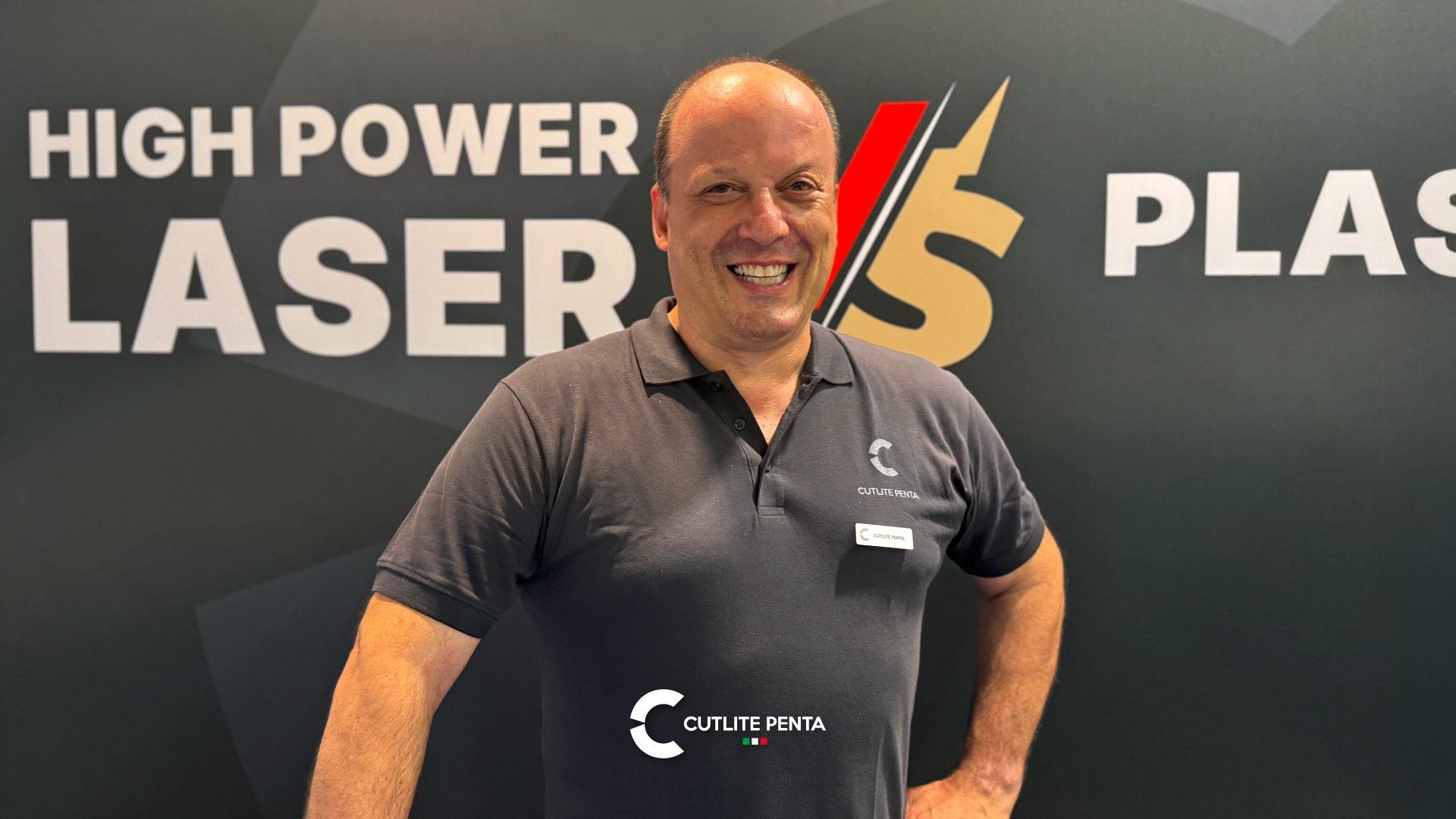
From 800 W to 60 kW: Lucio Verdi on the evolution of laser cutting
The first machines installed around 2000 cut with 800 W. Today our most powerful system uses 60,000. Lucio Verdi has walked every step in between.
Lucio Verdi is a technical sales engineer at El.En., assigned to Cutlite Penta. He joined the group over twenty years ago, when the CO2 laser was still the reference technology and Cutlite Penta was known for systems on thin sheet, plexiglass and dies. From there to today's high-power fiber laser runs the whole technical history of the company, told by the person whose job is explaining it to customers.
How it started, and what came before fiber
How did you join El.En.?
“More than twenty years ago I joined El.En. with experience already gained in the laser world, drawn in by how the CO2 laser was developing in the 2000s. Cutlite Penta, already part of the El.En. group, was known for laser systems on thin sheet, plexiglass and dies.”
Today Lucio is a technical sales engineer: the technical side of the customer relationship, from evaluating the purchase to getting the machine into production.
The first machines: from 800 W to 6 kW
“I have lived through the whole evolution of laser systems. El.En. and Cutlite Penta invested heavily in research and development, raising the power levels and improving the machines constantly. We installed the first ones around 2000, going from 800 W up to 6 kW, and exporting them worldwide.”
“From 2004-2005 customers started asking for customized systems, so we designed larger and larger machines.”
2009: a machine that ran around the clock
“In 2009 came the special project with Toscana Lamiere: a very large machine, with fully automated loading and unloading and 5 kW of power, able to run on its own 24 hours a day. It gave us excellent input for the future.” The market wanted more performance and less maintenance, and the answer back then was lasers with magnetic turbines. A limit on thickness remained. “The arrival of the fiber laser solved those limitations.”
The move to fiber laser
“Our managing director Delio Mugnaioni believed in the fiber laser right away. At the beginning they were very low power sources, for medium to thin material, but the evolution was extremely fast.”
The steady climb in power led to today's 60 kW on flat cutting, installed at Acciaieria Lucchini.

At LAMIERA 2025 and at our CUTLIVE25 open house we presented, for the first time in Europe, an FHD with a 60 kW IPG Photonics source and bevel cutting. It is the highest power we currently handle on flat cutting.
The advantage of having every department in one place
“The strength of our Prato site is having all the departments in house and close together: research and development, production, sales, service and the software department.” The software is not bought in: it is written in house, on our machines.
From Smart Manager to Smart Manager Plus
“Smart Manager has evolved into Smart Manager Plus, which has widened what we can do considerably. Several customers have already upgraded the platform, for the better functions and the easier operation.” It is the control system shared across the whole range: learn one of our machines and you can run the others.
In Genoa, the test piece that went to welding without cleaning
At GNS 13, the Italian National Welding Days held in Genoa on 26 and 27 June, we brought a test prepared with Stefano Cattaneo, president of Cutlite Penta. “We tested bevel cutting on medium to thick material, to show that cutting in gas mix at high power gives direct weldability, with no secondary processes such as deburring or cleaning.”
“The sectioned test piece, with no cleaning at all, showed excellent penetration and direct weldability.”
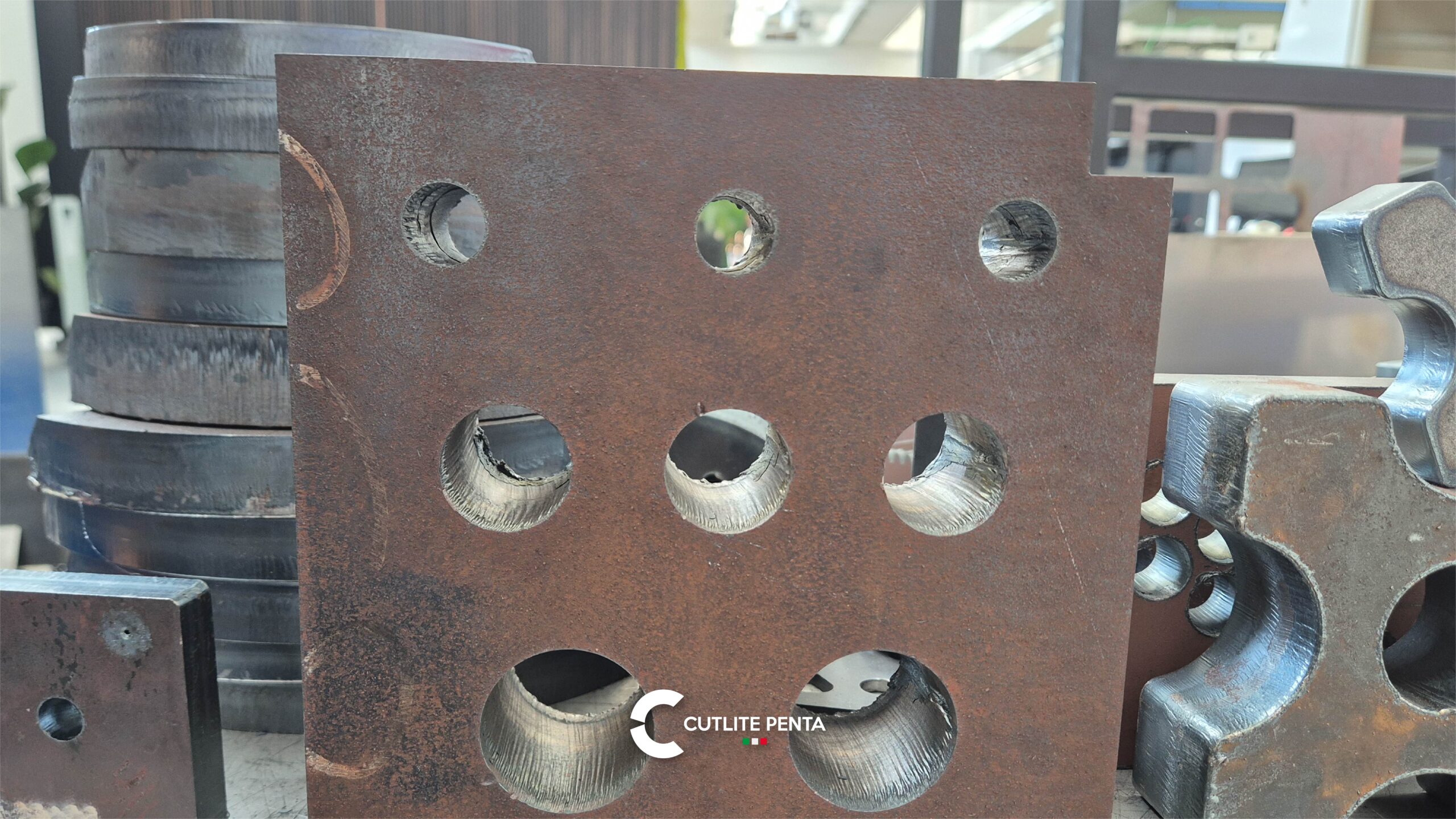
“That opens interesting prospects for shipbuilding and rail, where these processes are critical on large structures.” They are the two sectors where thickness is heavy by definition, and where every rework step before welding gets multiplied by the number of parts.
What to check before you sign a quote
The market has diversified a lot and prices have spread downwards. “Plenty of companies came back to us after buying a machine chosen on price alone.” For Lucio the item that makes the difference is not the purchase price, it is the service and what can actually be serviced. Four things that never show up on a quote and are worth asking about, of us and of anyone else:
- What kind of source is fitted? We never use single-module sources: on all our machines we fit serviceable systems, from the combiner to the modules to the control boards. If a module fails you replace that module, not the whole source.
- Are the guards compliant with European standards? The inspection windows of the enclosure and the safety devices must come with conformity documentation: ask for it and read it.
- Which gas does the chiller use? The refrigerant gases allowed in Europe are a defined list, and not every chiller on the market is on it.
- How fast does service arrive, and from where? This is the question worth most of all, because it is the one you pay for in downtime.
These are checks anyone can run in half an hour, and they head off a cost that never appears on the quote: bringing the machine into compliance, which you discover the day a safety inspection turns up.
On price we have worked too: the XMF and XME systems keep Cutlite Penta quality at a more accessible investment. “We know how to design special machines for any requirement, but we also wanted to give everyone the chance to buy a quality Italian machine.”
The technical sales job
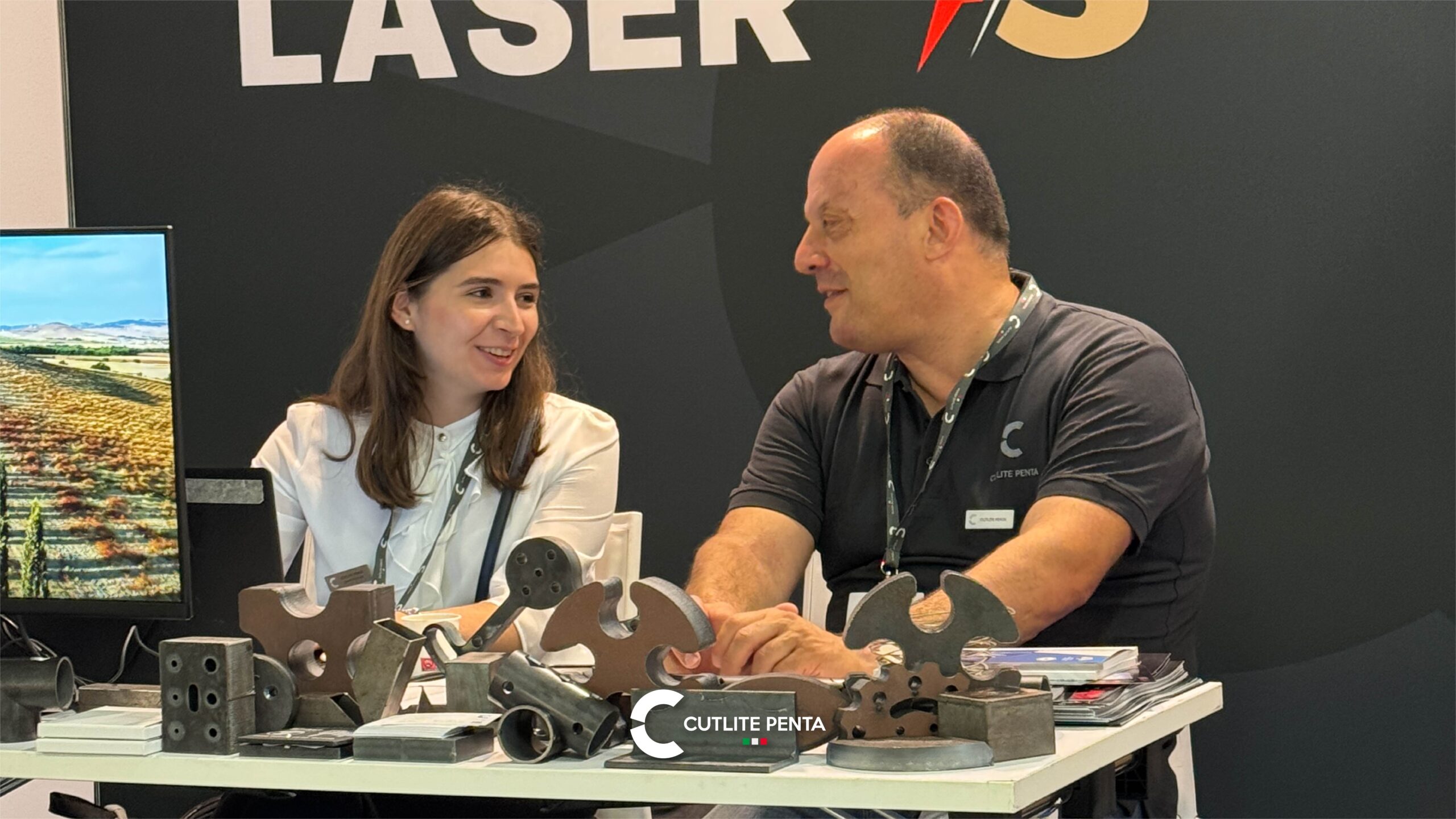
“Being a technical sales engineer means coming to the customer from the technical side, while they are evaluating a purchase. That builds trust, because they are dealing with a technician who may end up working on their machines, not with a salesman. It is a job that takes close attention, but it is very satisfying.”
How do you see the future of the company?
“Bright. The company is growing fast, with plenty of projects in the pipeline. And after thirty years in this work, seeing young people work with that kind of enthusiasm still gets to me.”
“At CUTLIVE25 the average age of the people running the machines was no more than 27 or 28.”
“We have gone from the first low-power CO2 lasers to today's 60 kW in fiber. These power levels are moving a lot of work from plasma to laser, including in sectors that used to belong to plasma alone. What matters is passion, curiosity and wanting to keep learning: anyone entering this world needs the same mindset.”
Frequently asked questions
How long has Cutlite Penta been building laser cutting machines?
The first machines were installed around 2000, with power levels going from 800 W to 6 kW and exported worldwide. From 2004-2005 the company began designing customized and large-format systems. Today the maximum power on flat cutting is 60 kW.
What is Smart Manager Plus?
It is the control system of Cutlite Penta machines, developed in house by the software department and the evolution of the earlier Smart Manager. It is shared across the whole range, and several customers have upgraded already installed machines to the new version.
What is the difference between a single-module and a multi-module laser source?
Serviceability. On a multi-module source like the ones we fit, the combiner, the modules and the control boards are accessible: if a module fails you replace that module. On a single-module source a fault means replacing the complete source.
What should you check before buying a laser cutting machine?
The type of source and how serviceable it is, the conformity documentation of guards and safety devices against European standards, the refrigerant gas used by the chiller, and service response times. None of these appear on the quote, but all of them get paid for later.
Want to talk to a technician instead of a salesman?
Tell us what you need to cut: we'll tell you which system and which power level make sense for your work.
