


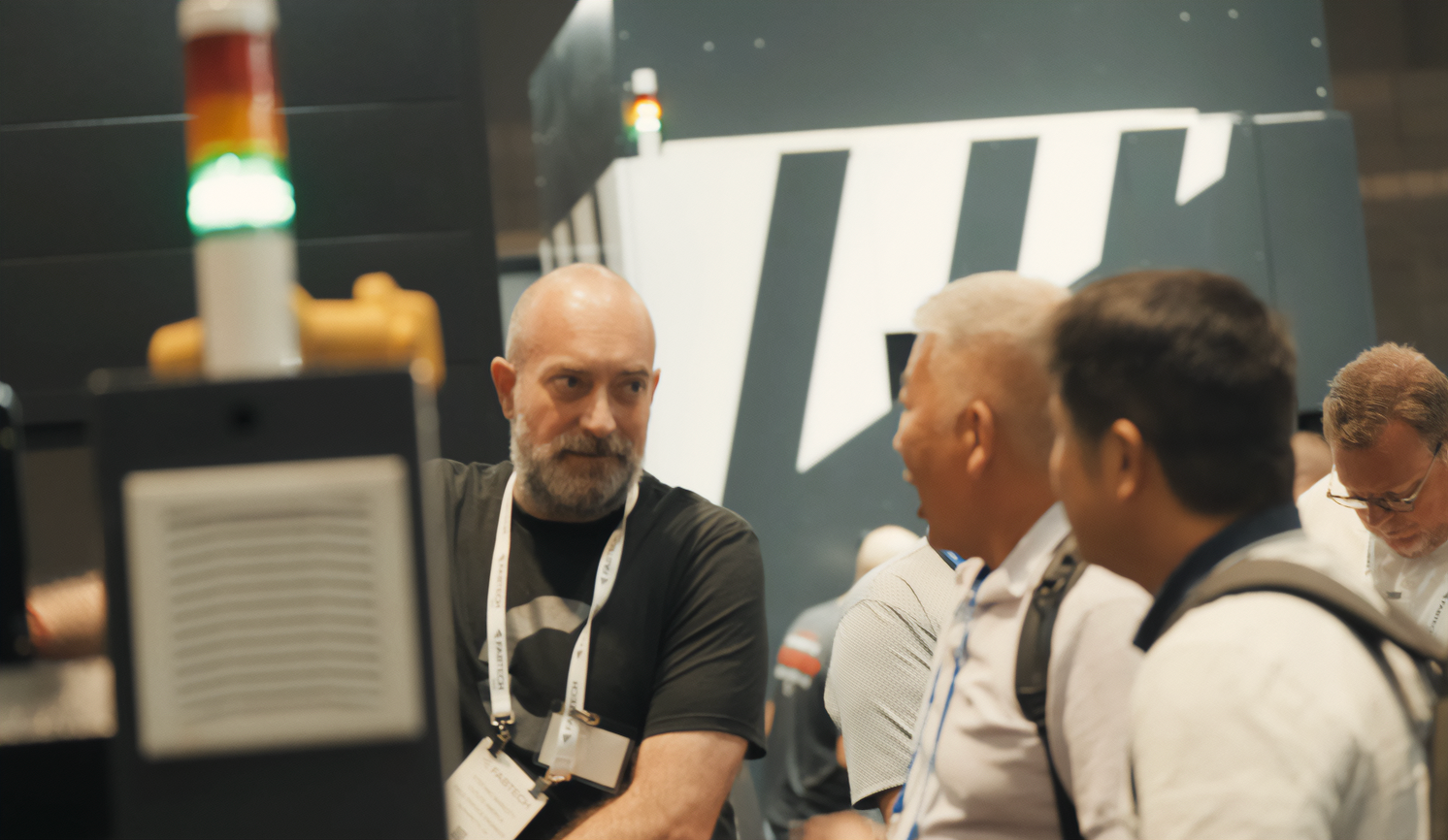
From Italy to Atlanta: the high power that is replacing plasma in the United States
In the United States plasma and oxyfuel cutting are still the shop-floor default. High-power fiber laser is replacing them one installation at a time, and the shops that make the switch do not go back.
Stefano Mariotti is an Italian service engineer who has been working from the United States since 2023, at the Cutlite Penta America site in Atlanta: he installs the machines, handles service and trains the American technicians. We asked him what actually changes when a shop moves from plasma to high power, and how you keep a service organization running in a country where a customer who is nearby is still five hours away by car.
From commissioning trains to laser: how the story starts
Mariotti joined Cutlite Penta on November 20, 2017, almost by chance. He knew someone who already worked here and, half joking, had asked to be told if we were ever looking for a technician. He was hired that same month.
The curious part is that he did not come from laser: before that he worked on testing and commissioning trams, subway cars and trains. At Cutlite Penta he started in service, on the CO2 machines and the cutting dies, then moved to metal when sheet metal cutting started growing in Italy. “On my first day I did not even know laser machines existed.”
What he needed was not laser knowledge but method: testing, analyzing a problem, hunting down a fault is exactly what he had been doing for fourteen years. The rest he learned next to one specific person: Gianni Berlincioni, employee number 1 at Cutlite Penta and the veteran technician of CO2 machines and cutting dies.
I spent a year with him, like his shadow.
A year of shadowing does not only teach you the machine. It teaches you how to behave at a customer site, and how to handle a day on the shop floor when production is down and everyone is looking at you. That is the part of the job no manual covers, and it is why Mariotti now does the same thing with the American technicians.
When America comes along
The first real contact with the American market is 2022, after our first FABTECH, with the installation of the first machines for Cupples J&J, in Tennessee. What struck him immediately was not technical: “the relationship with customers is very professional, but at the same time direct and friendly. It is different from Italy.”
In 2023 he was asked whether he wanted to try relocating to the United States. He accepted. Since FABTECH 2023 he has been there permanently.
Living and working in the United States
Relocating was not easy, and Mariotti does not pretend otherwise. “Living here is not like a few weeks on the road: when you do not know when you will go back to Italy, the way you handle everyday life changes completely.”
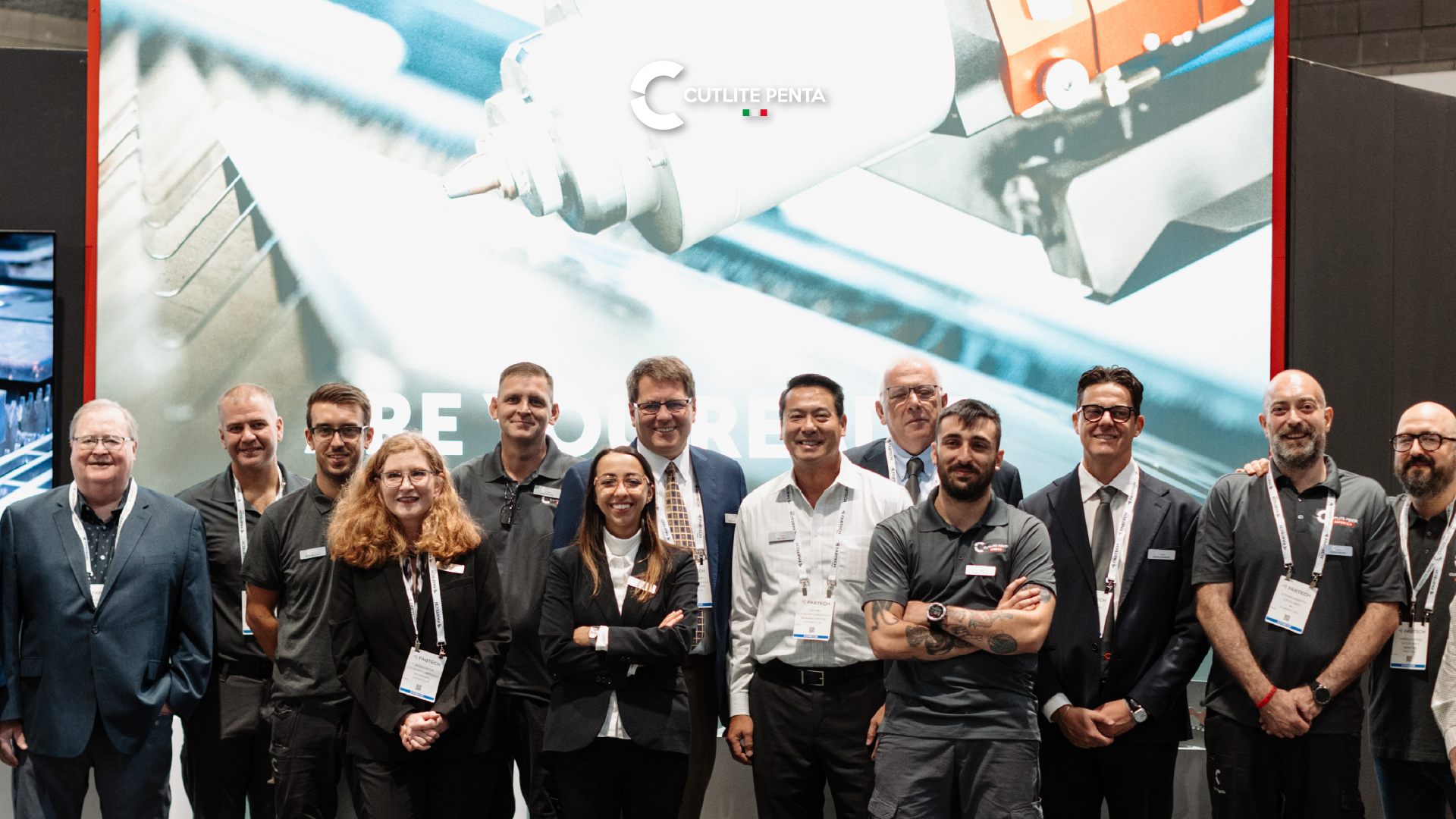
What made the difference was the environment. The Atlanta area is pleasant, and at Cutlite Penta America he found colleagues who were helpful both on and off the job: he mentions Mark Doxtader and Tan Tam for the human side, which partly makes up for the distance from home. Language, a challenge at first, was never a real limit either: slang changes a lot from region to region, but on the shop floor technical conversation always finds a way to work.
What an Italian technician does at Cutlite Penta America
“I do what I did in Italy, but with a wider role.” In practice the work splits like this:
- installations: commissioning machines at customer sites
- service: interventions and diagnostics when production stops
- remote support, when the problem can be closed without boarding a plane
- training the American technicians, the part that is growing fastest
There are many technicians in America, spread across enormous territories far from the Atlanta site: running continuous training is not simple. When it can be done, we run dedicated training weeks. It is the same pattern in reverse as the course in Prato for the Cupples J&J technicians: whoever has to service a machine needs to have run one first.
Why method matters more than procedure
On the value of the so-called “Italian method” Mariotti is blunt. It is not knowing what to do: it is knowing how to tackle a problem nobody had planned for.
Method is not only knowing what to do, but how to tackle problems.
The example he gives is the installation of the first laser tube cutting machine in America, near Nashville. Two Italian technicians worked alongside an American technician: not only to build the machine, but to leave skills behind for the installations that follow.
It is the slower and sturdier way to build a team, and it is also what the customer notices. In his own account, Jeff Cupples puts it in his own words: “the Italian technicians actually know how to run the machines and cut with them, so they can diagnose what is wrong and fix it faster.”
The American market: distances, powers, numbers
“Very intense” is how Mariotti describes the situation. When we speak he has five or six machines to install across the United States, Canada and Mexico, plus a second machine on its way to Mexico.
The real complexity, though, is not the number: it is the distances. “When a customer is close by we are still talking four or five hours by car, otherwise hours of flying.” It is not comparable to Europe, and it changes how you organize service: the group sites, Cutlite Penta America included, exist for this too, namely having cutting heads and spare parts already on the right continent.
On installed numbers: there are around fifty of our machines in America, most of them between 20 and 30 kW, with one 50 kW in production. That is not a detail: it is the portrait of a market that buys high power as the standard, not as the exception.
Why high power is taking plasma's place
Most American customers come from plasma or oxyfuel cutting. The move to high-power fiber laser is a big one, but in Mariotti's experience nobody goes back: cycle times change, cutting quality changes, the way production is organized changes.
The comparison between the two technologies is not ideological and comes with precise conditions, which we lined up on the plasma or laser page: plasma remains a valid choice when tolerances are wide and the part will be reworked anyway. When the edge has to come off the table finished, the gap shows.
For the people at the machine, the switch takes time. “At the start it is normal to struggle, especially on bevel machines.” Then the operator gets into the logic of the machine and the problems drop quickly. That is worth knowing before you buy, not after: a technology jump is also paid for in weeks of learning.
Cupples J&J and the 50 kW
The project Mariotti puts at the top is the installation of the first Cutlite Penta 50 kW in the United States, at Cupples J&J. After the early stages the machine runs without trouble and is fully productive.
Cupples J&J is a large operation: more than twenty laser machines, six of them ours, in almost every configuration we build. In his own account, Jeff Cupples explains why at a certain point he switched off every plasma system, and what the 50 kW lets him do today: “with the 50 kW we can cut 50 mm, two inches, in Gas Mix, and it beats plasma every time.”
Why the United States is a good market for Cutlite Penta
On high power Europe started earlier: in the United States the curve began later, and for us that means room to grow. It also takes the kind of machine we build: large formats and configurations tailored to the customer's job, not off a catalog. The machine on the cover, for instance, is an FHD.
Mariotti closes without any fanfare, which is how technicians talk: “I think in America we can only grow. And for now, I see myself here.”
Frequently asked questions
Who is Stefano Mariotti?
An Italian Cutlite Penta service engineer, with the company since November 20, 2017 and in the United States since 2023, at the Cutlite Penta America site in Atlanta. He handles installations, service, remote support and training for the American technicians. Before laser he worked on testing and commissioning trams, subway cars and trains.
How many Cutlite Penta machines are installed in the United States?
At the time of the interview, around fifty, most of them between 20 and 30 kW with one 50 kW in production. Installations also cover Canada and Mexico, with five or six machines waiting to be commissioned.
Is high-power laser replacing plasma in the United States?
Yes, and it is the main movement in the market: most American customers come from plasma or oxyfuel cutting. The best documented case is Cupples J&J, in Tennessee, which eliminated every plasma system when it introduced the 30 kW laser and today also runs a 50 kW.
How long does an operator need to move from plasma to laser?
A few weeks of adjustment is normal, especially on bevel machines, where parameters and sequences are more involved. Once the operator gets into the logic of the machine the problems drop quickly: it is a learning cost to put into the plan, not a permanent difficulty.
Are you weighing the jump from plasma to high power?
Bring us the material, thicknesses and tolerances of your parts: cutting gets tested in our DEMO area in Prato. And if you work in the United States, Canada or Mexico, Cutlite Penta America is in Atlanta.
